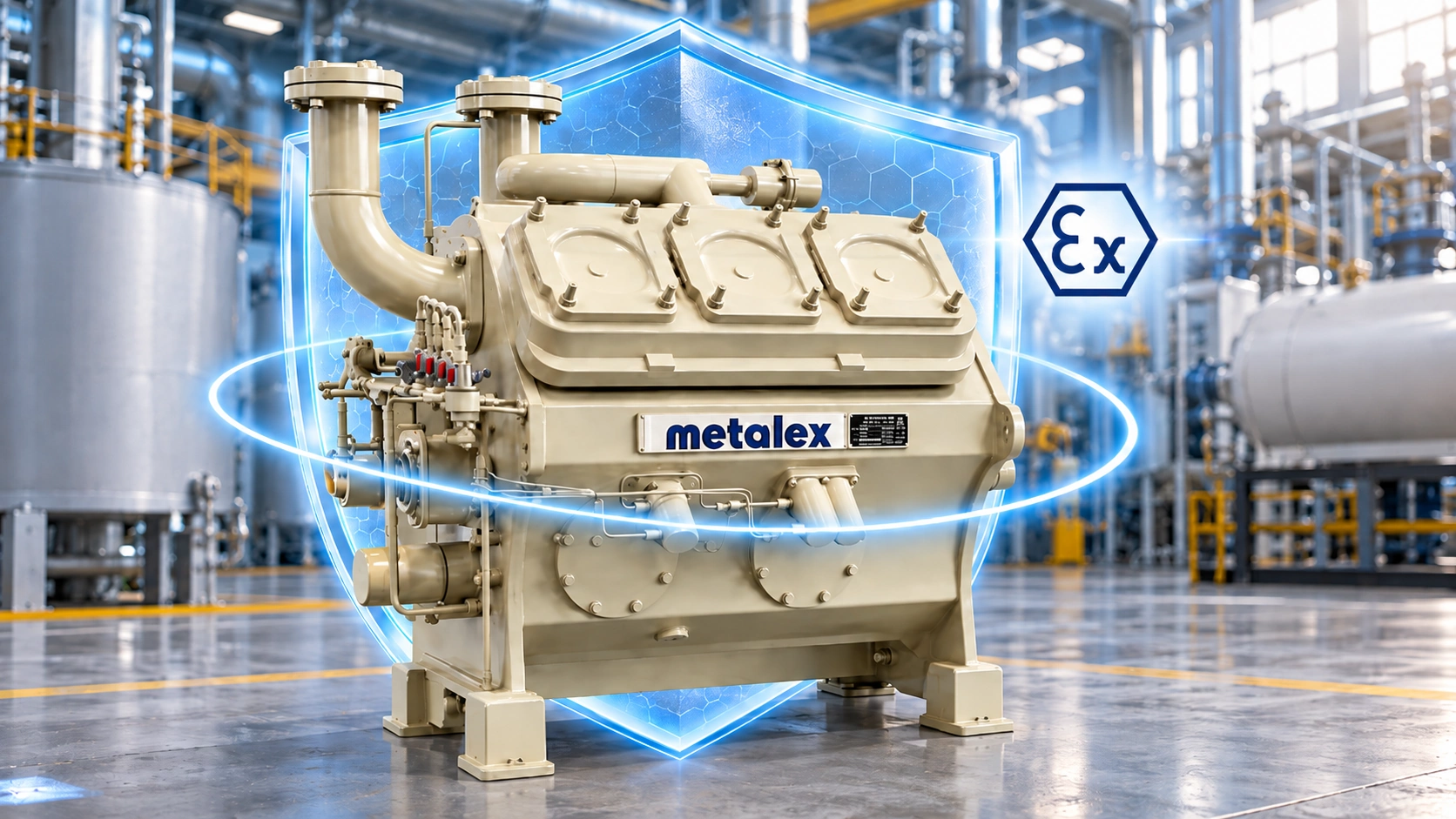
When a buyer searches for an explosion-proof reciprocating ammonia piston compressor, the requirement is broader than the mechanical compressor alone. The compressor must match capacity and operating duty, while motors, controls, switches and hazardous-area electrical equipment must suit the actual classification where one applies. A reciprocating ammonia piston compressor should therefore be evaluated as part of the complete industrial R717 refrigeration and machinery-room safety design.
Current industrial refrigeration search and market language increasingly overlaps with R717 ammonia compressors, natural refrigerants, energy efficiency, cold storage, food processing and seafood refrigeration. For buyers, these themes still lead back to the same engineering basics: correct compressor duty, safe ammonia machinery-room design, suitable electrical protection and reliable long-term operation.
What “Explosion Proof” actually means in an ammonia compressor project
In hazardous-area terminology, “explosion-proof” or “flameproof” mainly describes approved electrical protection methods for equipment that may be installed where a flammable atmosphere can occur. It should not automatically be used as a certification label for the mechanical compressor body. For a reciprocating ammonia piston compressor installation, the first engineering question is therefore not “Is the compressor explosion-proof?” but “How is the area classified, and which hazardous-area electrical equipment must be approved for that classification?”
Ammonia is primarily a toxic and corrosive hazard, yet high concentrations can also burn. The research used here notes an anhydrous ammonia flammable range of about 16 to 25 percent in air and warns that an enclosed release with an ignition source can create an explosion hazard. Ventilation, leak detection and emergency controls therefore belong in the same design discussion.
For Indian projects, area classification and hazardous-area electrical equipment selection should be reviewed against applicable BIS standards and project-specific PESO requirements where PESO jurisdiction applies. IIAR 2-2021 can also inform machinery-room, detector, alarm and ventilation decisions. The proposed 2026 IIAR 2 revision was still under public review in the research used here, so it should not be presented as a final issued standard.
How a reciprocating ammonia compressor works with R717
A reciprocating ammonia piston compressor uses pistons inside cylinders to draw in low-pressure ammonia vapour and compress it to a higher pressure for condensation. “Piston compressor” and “reciprocating compressor” describe the same core principle here, so terms such as reciprocating ammonia compressor, ammonia piston compressor, R717 reciprocating compressor and NH3 reciprocating compressor are closely related.
Metalex describes its ammonia piston compressor range as reciprocating compressors for industrial R717 refrigeration. Depending on the duty, projects may use single-stage or two-stage compression. Air-cooled examples include the MXT-400 reciprocating ammonia compressor and MXT-800, while lower-temperature duties may lead engineers to review a two-stage option such as the MX-310 two-stage ammonia compressor.
The right reciprocating ammonia piston compressor is not selected from cylinder count alone. Capacity changes with suction condition, condensing condition and operating profile. A machine suitable for a medium-temperature cold room may not suit a deep-freezing process with a much higher pressure ratio.
Electrical protection in hazardous or classified areas
Where a classified area applies, Explosion Proof electrical equipment deserves the same attention as the compressor duty. Potential ignition sources can include the drive motor, starter, control panel, switches, junction boxes, field instruments, transmitters, solenoids and other powered devices. For a reciprocating ammonia compressor project, those components should be selected according to the area classification, gas group, temperature requirements, protection concept and local approval route established by the competent engineer and authority having jurisdiction.
Terms such as explosion-proof electrical equipment, flameproof electrical equipment and Ex-rated devices are often used loosely, but they are not interchangeable marketing labels. A practical RFQ should separate the mechanical compressor specification from motor and electrical-package requirements, then state the applicable zone or division, certification basis, ambient condition and site electrical standard.
An existing plant upgrade may need more than compressor replacement. Plant upgradation and safety review can include electrical works, control logic and instrumentation. Refrigeration project consulting helps connect the compressor decision with the complete plant.
Ventilation, ammonia detection and emergency controls
An explosion-protection discussion is incomplete without ammonia release management. An ammonia machinery room should be assessed for ventilation, detector location, alarms, emergency controls and safe access. Ammonia compressor room ventilation is not a substitute for good containment, but it helps manage abnormal releases and dangerous accumulation.
Ammonia leak detection should be integrated with alarms, ventilation response and emergency controls rather than treated as a standalone sensor purchase. The actions must suit the actual ammonia machinery room and governing requirements. Operating and operator support is relevant where teams need structured training and troubleshooting procedures around industrial R717 refrigeration systems.
How to select an ammonia piston compressor
Good ammonia compressor selection begins with load and operating temperatures. For a reciprocating ammonia piston compressor, provide capacity, suction or evaporating condition, condensing condition, operating hours, ambient temperature, power supply, cooling-water availability, control preference and expansion needs. These inputs guide staging and air-cooled versus water-cooled selection.
- Duty: refrigeration capacity at the actual operating condition, not only a nominal TR value.
- Temperature level: suction or evaporating temperature and condensing temperature.
- Operating profile: continuous duty, seasonal peak, pull-down requirement and part-load behaviour.
- Utilities: available electrical supply, ambient conditions and cooling-water availability where relevant.
- Safety basis: machinery-room design, electrical area classification, detection, ventilation and emergency controls.
- Future requirement: standby philosophy, expansion allowance and maintenance access.
Metalex supports industrial refrigeration applications across cold storage, dairy, food processing, ice plants and process cooling. The broader industrial refrigeration equipment range can be reviewed when the compressor is being specified with condensers, vessels, valves and supporting plant equipment. Energy should also be considered at system level; the Metalex guide on reducing power consumption in industrial refrigeration is useful when evaluating operating strategy beyond compressor selection alone.
For cold storage, food processing, dairy, meat, seafood and ice-plant projects, the same R717 ammonia compressor can face very different suction conditions, operating hours and load profiles. A cold storage ammonia compressor should therefore be selected from the actual refrigeration duty rather than from a generic model or horsepower comparison.
Installation, isolation and maintenance safety
Installation and service work on an ammonia refrigeration compressor should be carried out by trained personnel under approved procedures. Before maintenance, the plant must have a defined shutdown and energy-isolation process, including lockout and control of stored electrical and mechanical energy. Refrigerant isolation, draining or line blocking may also be required depending on the work scope.
Suitable PPE, emergency planning, ventilation and access controls should reflect the task and exposure risk. Planned inspection and competent service help prevent abnormal vibration, leakage, control faults or electrical defects from becoming larger plant problems. Metalex technical support and service resources can assist with compressor support and training, while refrigeration plant servicing covers broader plant-maintenance needs.
Metalex reciprocating ammonia compressor options for industrial projects
Metalex offers industrial ammonia compressor options for R717 duty with air-cooled and water-cooled arrangements and selected single-stage or two-stage configurations. The best reciprocating ammonia piston compressor is matched to the duty point, utilities, staging and safety basis. Explosion-proof electrical equipment should be specified through the correct hazardous-area requirements, not added as an unsupported blanket claim.
For new installations and upgrades, review the compressor together with the motor, controls, instrumentation, ventilation, detection and service access. This gives plant owners a clearer RFQ and separates mechanical performance from hazardous-area electrical compliance.
For buyers comparing an ammonia compressor manufacturer in India, the RFQ should state the R717 duty point, capacity, suction and condensing conditions, motor and electrical protection requirements, cooling arrangement, controls, ambient conditions and required service support.
Explosion protection and ammonia safety references
These references support the specific engineering points discussed in this article: ammonia hazards, hazardous-area electrical classification, Ex-rated electrical equipment and machinery-room ventilation. They are included as technical references, not as product endorsements.
Machinery rooms, compressors, instrumentation, controls, ammonia detectors and alarms.
Technical context for ventilation design in industrial refrigeration machinery rooms.
Official ammonia physical properties, health hazards and flammability information.
Electrical protection methods and classified-location requirements in the US framework.
India-specific reference for classification of hazardous areas involving flammable gases and vapours.
Official Indian guidance for Ex electrical apparatus approval where PESO jurisdiction applies.
Explore compressor models, cold storage and turnkey refrigeration solutions
Use these related Metalex and Refrigeration Projects resources to compare compressor series, individual models, storage applications, processing lines, meat and seafood plants, dairy projects, ice factories and plant-support services.
Compressor series
IS / ISH Series — complete model range
MXT / T Series — complete model range
Metalex products, industries and support
Metalex technical reading
Turnkey refrigeration project categories
Fruit, vegetable and commodity cold storage
Cold storage facilities
Food processing lines
Meat, poultry and seafood projects
Dairy processing projects
Ice factory projects
Consulting, upgrades and plant support
Refrigeration Projects technical reading
Quick routes for buyers and project teams
- Compare MX Water Cooled Series
- Compare IS Air Cooled Series
- Compare MXT T Series
- Select an Ammonia Piston Compressor
- Review Industrial Refrigeration Products
- Explore Cold Storage Projects
- Explore Processing Lines
- Explore Meat & Seafood Projects
- Explore Dairy Projects
- Explore Ice Factory Projects
- Discuss a Turnkey Project
- Get Quotes from Metalex
Share your ammonia compressor duty and hazardous-area requirement
Send the refrigeration capacity, evaporating and condensing conditions, application, utilities, site ambient, electrical classification details and expansion requirement. Metalex can review the compressor duty and the information required for a project-specific quotation.
Get QuotesExplosion-proof ammonia compressor FAQ
What does explosion-proof mean for a reciprocating ammonia piston compressor?
It generally refers to properly selected electrical protection for equipment installed in an applicable classified area. It should not automatically be treated as certification of the complete mechanical compressor.
Is ammonia flammable or explosive?
Ammonia is primarily a toxic and corrosive hazard, but sufficiently high concentrations in air can burn. An enclosed release combined with an ignition source can create an explosion hazard.
Does every ammonia compressor room require explosion-proof electrical equipment?
No. The area must be assessed under the applicable classification rules, project design basis and local authority requirements. Electrical protection should follow the actual classification, not a blanket assumption.
Which electrical components may require Ex-rated protection?
Depending on the area classification, requirements may apply to motors, starters, switches, junction boxes, control equipment, instrumentation, sensors and other powered devices within the classified location.
What information is needed to select an ammonia piston compressor?
Provide capacity, suction or evaporating condition, condensing condition, operating hours, ambient temperature, power supply, cooling-water availability, control requirements, load profile and future expansion.
Why are ventilation and ammonia detection important in a compressor room?
Ventilation, detectors, alarms and emergency controls form part of the ammonia machinery room safety strategy used to identify and manage abnormal ammonia releases and limit dangerous accumulation.
Can Metalex support project selection and service planning?
Yes. Metalex provides compressor and technical support, while Refrigeration Projects covers consulting, plant upgradation, operating support and service planning for industrial refrigeration projects.
Do I need an explosion-proof motor for an ammonia compressor?
Not automatically. The motor and other electrical equipment should be selected for the actual hazardous-area classification, protection method and project requirements established by the competent engineer and applicable authority.
Why is R717 ammonia used in industrial refrigeration and cold storage?
R717 ammonia is widely used in industrial refrigeration because it is a natural refrigerant with strong thermodynamic performance for large refrigeration duties. System design must still address toxicity, detection, ventilation and safe operation.