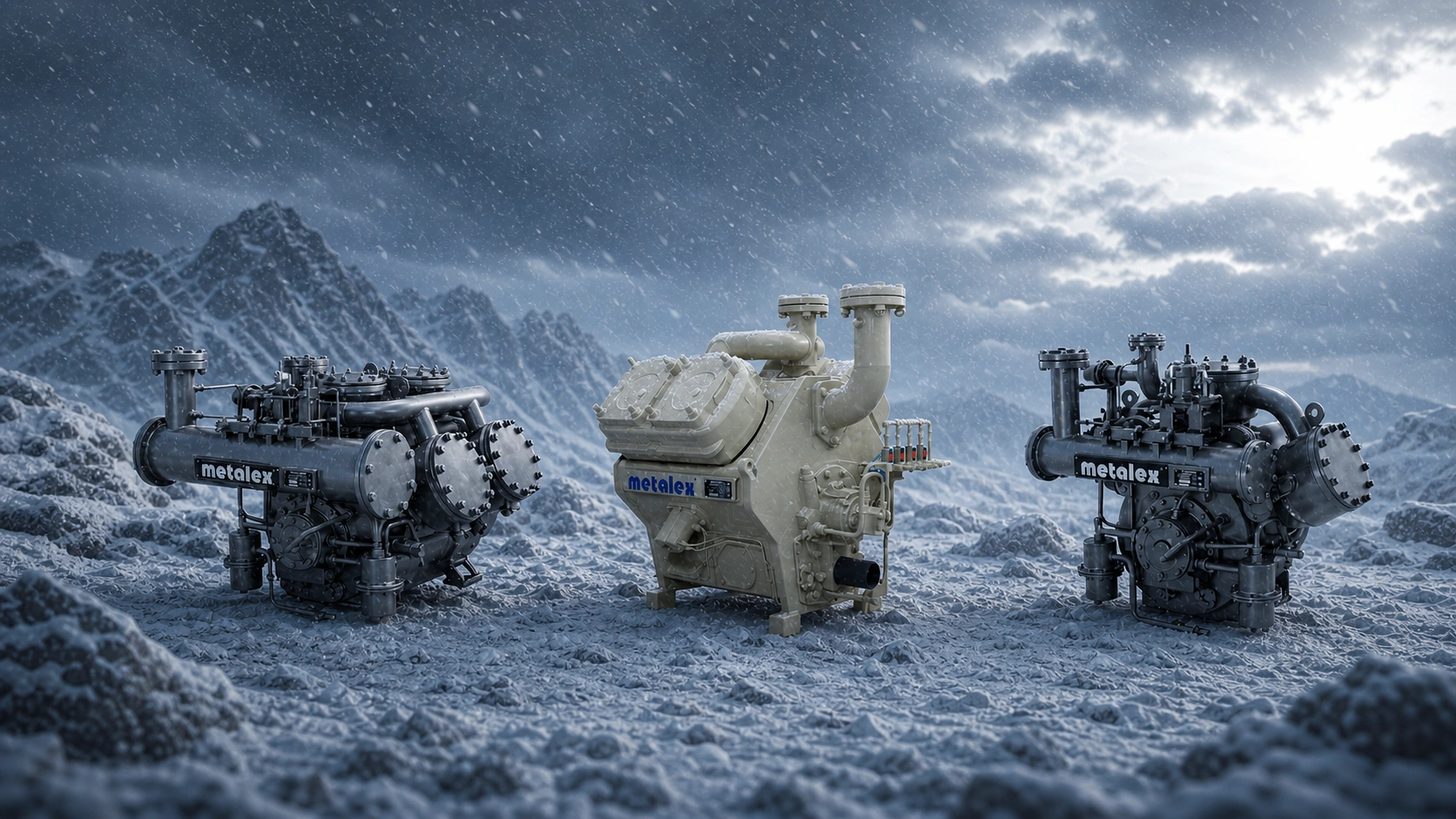
A reciprocating ammonia compressor is widely used in industrial R717 refrigeration where service access, maintainability, operating flexibility and dependable long duty cycles matter. The compressor, however, cannot be selected in isolation. A cold store in peak harvest season, a dairy during milk collection, an ice plant at full production and a seafood freezer can impose very different suction conditions, load profiles and operating hours.
Metalex organises its ammonia piston compressor range into three main families: the MX Series water cooled compressors, the IS Series air cooled compressors and the MXT Series, also referenced as the T Series. Supporting refrigeration plant equipment, evaporative condensers, ammonia pressure vessels, controls, valves and service support are then selected around the complete refrigeration duty.
Start with the refrigeration duty, not the series name. MX Series suits projects where water cooled compressor operation is practical. IS Series gives air cooled single stage and two stage options for sites where compressor cooling water is limited or difficult. MXT Series is a single stage air cooled T Series range for industrial NH3 duty with higher speed and service focused construction. The final model must be checked at the actual evaporating and condensing conditions.
Industrial refrigeration starts with the duty, not with a compressor catalogue
Plant owners often begin with a question like, “Which compressor size do I need?” The useful engineering answer starts one step earlier. What is the product, what temperature must it reach, how fast must the heat be removed, how long does the plant run, what does the site ambient look like, and which utilities are dependable? These questions change the suction condition, condenser duty, compressor capacity, number of machines, staging arrangement and standby philosophy.
The Metalex industries page describes the same approach across dairy, agricultural produce, cold storage, ice plants, seafood, food processing, pharma and process cooling. Each one can use ammonia refrigeration, but every application creates a different mix of pull down, holding load, process heat, door load, defrost, humidity, production peaks and future expansion. The equipment selection has to follow that mix.
These requirements explain why an industrial ammonia compressor, NH3 piston compressor or R717 refrigeration compressor should be treated as an engineering category rather than one universal machine. Cold storage, dairy, ice plants and process refrigeration can all use reciprocating compression, but the suitable series, stage arrangement and supporting equipment depend on the actual duty point and site utilities.
Complete Metalex reciprocating ammonia compressor range
The interactive selector below is not a sizing tool. It is a clean way to browse the current compressor families without turning a long technical article into a wall of model names. Every card is clickable. IS Series cards use their dedicated model pages. MXT cards use their dedicated current model pages. MX cards point to the main MX Series selection page so final model data can be checked at the correct rating condition.
Metalex MX Series
The MX Series is the Metalex water cooled ammonia piston compressor family for industrial plants with dependable cooling water availability. The series covers medium temperature refrigeration as well as lower temperature two stage duties. Water cooled compressor selection should consider water quality, flow, treatment, maintenance and the actual plant operating condition.
Single stage MX models
Two stage MX models
Metalex IS Series
The IS Series is built for air cooled ammonia compressor applications where compressor cooling water is limited, hard or inconvenient to maintain. The current IS range is presented for demanding installations and high ambient conditions, with both single stage and two stage model choices.
Single stage IS models
Two stage IS models
Metalex MXT Series
The MXT Series, also referenced as the T Series, is a single stage air cooled reciprocating ammonia compressor range. Current Metalex model pages position the range for industrial NH3 operation with no compressor water cooling, capacity control per cylinder and service focused construction.
How to choose between MX Series, IS Series and MXT Series
There is no honest answer based on model name alone. A compressor is selected at a duty point. That duty point has an evaporating temperature, condensing temperature, refrigerating capacity, refrigerant, speed, operating pattern and site condition. Change any of those and the useful capacity changes.
MX Series is a practical route where dependable compressor cooling water, treatment and maintenance are already part of the plant utility system.
IS Series is useful where compressor cooling water is difficult and the project may need either single stage or two stage ammonia compression.
MXT Series gives a current air cooled T Series route for cold storage, ice plants, dairy, food processing, fish and meat processing and process refrigeration.
For consultant review, the useful inputs remain the same: required refrigeration capacity, suction or evaporating temperature, condensing temperature, site ambient, power supply, available water, operating hours, part load pattern and future expansion. The main Metalex product range and engineering contact page give a clean route when the duty has not yet been converted into a final model selection.
The compressor is the heart, but the plant around it decides performance
A strong reciprocating ammonia compressor cannot compensate for a weak condenser, unstable refrigerant feed, undersized vessel, poor oil management or careless controls. Industrial refrigeration works as a circuit. The compressor creates pressure difference, but the rest of the plant decides how efficiently heat moves from the product to the outside environment.
For older plants, the right answer may not be a new compressor. It may be condenser cleaning, valve work, vessel level correction, improved control logic, better maintenance access or a planned plant upgradation. That is why a plant audit should look at pressures, temperatures, compressor loading, condenser condition, refrigerant levels and product performance together.
Metalex ice machines and industrial ice plant refrigeration
Industrial ice production is one of the clearest examples of why compressor and machine selection belong together. An ice factory is not only a freezer. Feed water temperature, tonnes per day, ice geometry, hot gas harvest, condenser duty, storage, handling and daily operating hours all influence the refrigeration requirement.
Metalex tube ice machines are supplied for industrial ice production, with compressor, condenser and refrigeration controls selected around the required daily output and operating conditions.
View tube ice machinesCompressor, condenser, vessels, freezer, controls, ice storage, handling and utilities should be planned as one production system rather than as isolated equipment.
Explore industrial ice plantsFor a full block, tube or flake ice project, the turnkey route connects refrigeration selection with plant layout, storage, handling and operating support.
Explore turnkey ice factory projectsIce plant compressor selection should begin with the required daily production, feed water temperature, operating hours, ice type, storage requirement and dispatch pattern. Those inputs determine the refrigeration load and help define the compressor duty, condenser size and supporting equipment without forcing the decision around a nominal tonnes-per-day label alone.
Where Metalex industrial refrigeration runs
The same compressor family can appear in very different plants, but the refrigeration architecture changes with the product and process. The Metalex industries portfolio covers eight major operating segments; the examples below show how the operating requirement changes from one sector to another.

Milk chilling, chilled water, curd, paneer, butter, cold rooms and ice cream production support.
Industry 02Agricultural produceFruit, vegetable, potato, onion, pack house, pre cooling, ripening and multi commodity storage.
Industry 03Cold storageChilled rooms, frozen rooms, warehouses, multi zone stores and continuous temperature controlled duty.
Industry 04Ice plantsTube ice, block ice, flake ice and complete industrial ice factory refrigeration.
Industry 05Seafood and fisheriesCatch chilling, ice production, processing, quick freezing, frozen storage and reefer dispatch.
Industry 06Food processingProcess cooling, chilled water, rapid chilling, freezing, cold rooms and production integrated refrigeration.
Industry 07Pharma refrigerationProcess temperature control, utility cooling and industrial refrigeration selected around validated plant requirements.
Industry 08Gas LiquefactionChemical, petrochemical, beverage, brewery and other industrial duties where refrigeration is part of production.
A cold storage owner normally talks about room temperature and tonnage. A dairy talks about milk quantity and chilling time. A seafood processor talks about catch temperature, ice demand, freezing cycle and frozen storage. A food plant talks about recipe steps, line capacity and process heat removal. These are different conversations, and that is exactly why one generic compressor recommendation is not enough.
From compressor selection to complete refrigeration project execution
Metalex equipment pages are useful when the requirement is a compressor, ice machine, condenser, vessel or spare. When the requirement becomes a complete plant, Refrigeration Projects is the stronger route. It connects equipment selection with storage rooms, process lines, plant layout, project consulting and operating support.
What to share before selecting a compressor or refrigeration system
Good selection starts with useful data. A plant owner does not need a finished consultant drawing to begin. Even rough operating numbers can narrow the correct architecture quickly.
- Application: cold storage, dairy, ice plant, seafood, food processing, agriculture, pharma or another process duty.
- Required capacity: refrigeration load in kW or TR if available, otherwise product quantity, room size, production rate and pull down requirement.
- Temperature: incoming product temperature, target product or room temperature, evaporating temperature if known and required pull down time.
- Condensing condition: expected ambient, condenser type and design condensing temperature.
- Utilities: electrical supply, cooling water availability, water quality, drainage and backup power.
- Operating pattern: hours per day, peak season, loading pattern, production shifts and part load behaviour.
- Existing plant: compressor model, refrigerant, condenser, vessel arrangement, current pressure and temperature data, service history and present problem.
- Project stage: new plant, tender, expansion, replacement compressor, retrofit, energy improvement or urgent service requirement.
For equipment selection, use the reciprocating ammonia compressor hub, Metalex product range, service and spare support and contact page. For a complete plant, move directly to turnkey refrigeration solutions. This keeps the enquiry focused on what the plant has to achieve rather than forcing every requirement into one machine.
Reciprocating ammonia compressor and industrial refrigeration FAQ
A reciprocating ammonia compressor is a piston compressor used to compress ammonia refrigerant R717 in industrial refrigeration systems. It is commonly selected for cold storage, ice plants, dairies, food processing, seafood, process cooling and other continuous refrigeration duties.
MX Series is the Metalex water cooled reciprocating compressor range. IS Series is an air cooled ammonia compressor range with single stage and two stage model options. MXT Series, also referenced as the T Series, is a single stage air cooled reciprocating ammonia compressor range designed for industrial NH3 duty without compressor water cooling.
Single stage compression is considered when the evaporating and condensing conditions keep the required pressure ratio within a practical operating range. Final selection depends on the refrigeration load, target temperature, condensing condition and application.
Two stage compression is commonly considered for lower temperature duties where the total pressure ratio becomes too high for a practical single stage arrangement. Frozen storage, low temperature process refrigeration and selected freezing applications often require this type of review.
Metalex serves dairy, agricultural produce, cold storage, ice plants, seafood and fisheries, food processing, pharma and process cooling applications. The correct compressor series is selected from the actual duty and site utilities rather than the industry name alone.
Water cooled compressor arrangements require dependable cooling water flow, water quality and maintenance. Air cooled compressor arrangements avoid compressor cooling water, but final selection still depends on the duty point, ambient condition, staging requirement and the overall refrigeration system.
A complete plant can include condensers, pressure vessels, evaporators, refrigerant pumps, valves, purgers, control panels, safety hardware, piping and service access. These components should be engineered as one refrigeration system.
Provide refrigeration capacity, evaporating or suction condition, condensing temperature, refrigerant, operating hours, application, site ambient condition, available power, cooling water availability, control preference and future expansion requirement.
Yes. Refrigeration Projects covers turnkey cold storage, fruit and vegetable storage, processing lines, meat and seafood plants, dairy projects, ice factories and project consulting in addition to Metalex equipment supply.
Need help choosing an MX Series, IS Series or MXT Series compressor?
Share the application, refrigeration capacity, evaporating temperature, condensing condition, operating hours, project location and available utilities. Metalex can review the compressor family, supporting plant equipment and complete refrigeration route.