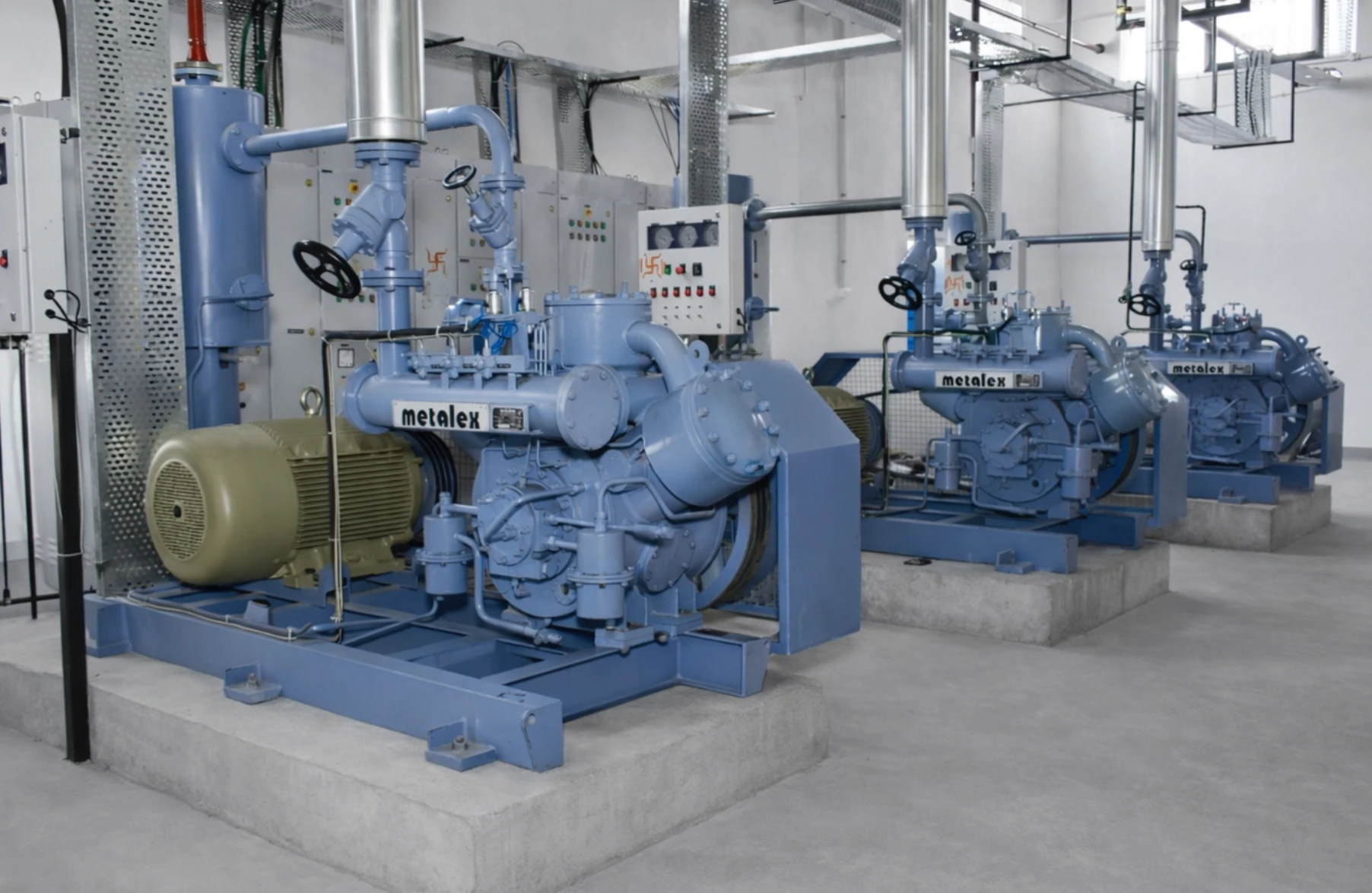
Pressure fluctuations in an industrial ammonia refrigeration system are not automatically a compressor fault. Suction pressure can move when product load changes, doors open, evaporators enter defrost, valves respond or compressors change capacity. Discharge pressure can move with condenser conditions, ambient load and refrigerant side issues. What matters is whether the plant settles into a predictable operating range and keeps product temperature under control. The Metalex IS Series provides single stage and two stage air cooled ammonia compressor options across a wider model range for industrial NH3 refrigeration.
Metalex builds and supports ammonia piston compressors for industrial refrigeration and provides the IS air cooled compressor range for plants where compressor cooling water is limited, difficult to maintain or simply not the preferred arrangement. The same plant level approach is used across Metalex refrigeration applications, because cold storage, dairy, ice production, seafood and process cooling do not create the same pressure behaviour.
Changing load, poor refrigerant feed, condenser problems, vessel level changes, valve hunting, control settings, defrost cycles, compressor staging and maintenance condition can all move pressure. A compressor can only work with the suction and discharge conditions the rest of the plant gives it.
What pressure actually tells you in an ammonia refrigeration plant
A pressure gauge does not tell the whole story by itself. It tells you what the refrigerant is experiencing at that point in the circuit. To understand whether the reading is normal, compare it with room temperature, evaporator demand, compressor loading, condenser condition and the operating sequence at that moment.
It responds to load, refrigerant feed, evaporating condition, defrost recovery and compressor capacity.
It responds to condensing conditions, ambient load, condenser cleanliness, airflow or water condition and non condensable gases.
In a two stage arrangement, the intermediate condition links the low stage and high stage sides and should be reviewed with the complete intercooling and vessel arrangement.
A stable gauge reading is useful, but product and room temperature recovery still decides whether the refrigeration system is doing the job.
For buyers planning a new plant, Metalex recommends starting from the actual duty point rather than a model name. The Metalex product range includes compressors and supporting plant equipment, while the plant equipment range covers items such as condensers, vessels, valves, purgers, controls and service support that influence system behaviour.
Common reasons pressure starts moving more than expected
A warm product batch, repeated door opening or production change can increase evaporator load faster than the plant was operating a few minutes earlier.
Incorrect liquid level, valve behaviour or unstable feed can change evaporator performance and make suction conditions move.
Higher ambient load, poor airflow, scale, fouling or weak heat rejection can raise discharge pressure. The Metalex evaporative condenser range is selected from real heat rejection duty and site conditions.
Receivers, accumulators, separators and surge vessels help the plant manage refrigerant correctly. Review the refrigeration pressure vessel range when planning or upgrading a system.
A control system that responds too quickly to small changes can create hunting. The plant should be tuned around its actual response time, not only a theoretical setpoint.
Valve condition, oil management, fouling, filters, instrumentation and compressor wear can slowly change plant behaviour. Metalex service and spare parts support can review symptoms with model and site information.
Read ammonia pressure together with saturation temperature
In an R717 ammonia refrigeration system, pressure is most useful when it is interpreted together with the corresponding refrigerant saturation temperature. Suction pressure relates to the evaporating condition, while discharge pressure relates to the condensing condition. A pressure reading that looks unusual in isolation may make sense once the actual room load, evaporating temperature, condensing temperature and plant sequence are reviewed together.
For troubleshooting, avoid treating one fixed pressure value as universally normal. The expected operating condition changes with product load, room setpoint, ambient or wet bulb conditions, compressor loading, condenser performance and system design. Use the pressure temperature relationship as context, then compare it with the plant's design duty and operating trend.
Pressure fluctuation diagnostic check
Use the pattern of the pressure movement to decide where to investigate first. This is a screening guide, not a substitute for plant specific operating limits or qualified ammonia refrigeration service.
| What you observe | Possible areas to investigate | What to compare |
|---|---|---|
| Suction pressure repeatedly falls | Refrigerant feed, evaporator load, restrictions, compressor capacity relative to load and evaporator condition. | Room temperature, liquid feed, compressor loading and the timing of the pressure drop. |
| Suction pressure hunts up and down | Control response, unstable feed, changing load, compressor staging, defrost recovery or instrumentation behaviour. | Valve position, defrost events, vessel level and whether the pattern repeats at the same operating event. |
| Discharge pressure keeps rising | Condenser heat rejection, fouling, airflow or water condition, ambient or wet bulb condition and non condensable gases. | Condenser approach, fan or pump operation, cleaning condition and the pressure trend as ambient load changes. |
| Intermediate pressure is unstable | Low stage and high stage loading, intercooling, vessel condition, feed balance and capacity staging. | Both compressor stages together instead of adjusting one stage from a single reading. |
| Pressure changes after product loading or defrost | The movement may be load related if the plant returns predictably to its normal operating range. | Recovery time, room temperature and whether the pressure settles after the event ends. |
| Pressure looks stable but room temperature is poor | Available refrigeration capacity, evaporator performance, airflow, refrigerant distribution and actual process load. | Room or product recovery, compressor loading and evaporator condition rather than pressure alone. |
A practical pressure stability check before changing settings
- Record suction, discharge and intermediate pressure together. One number without the others can hide the actual system condition.
- Check room temperature at the same time. Pressure should be compared with the result the cold room or process is seeing.
- Note compressor loading. Capacity changes can explain a pressure movement that otherwise looks random.
- Check condenser condition. Heat rejection problems often show up as rising discharge pressure and longer compressor run time.
- Review vessel levels and refrigerant feed. Poor feed stability can move evaporator performance and suction pressure.
- Mark defrost events. A pressure change during defrost recovery may be normal if the plant settles correctly afterward.
- Look for a pattern across several hours. Trend data helps separate a repeating operating event from a developing fault.
- Use service support when the pattern is unclear. Share logs, photos, videos, model details and plant history through Metalex technical support.
Why two stage ammonia compression is used for lower temperature duty
As evaporating temperature falls, the pressure ratio across a refrigeration compressor rises. For demanding low temperature applications, a two stage ammonia compressor arrangement can divide compression into low stage and high stage work. The final architecture still depends on refrigeration load, suction condition, condensing condition, refrigerant management and the application itself.
This is why a low temperature plant should be reviewed as a system. Compressor choice, intercooling, vessel sizing, condenser duty, refrigerant feed, controls and maintenance access all matter. A two stage compressor is not a shortcut around poor plant design.
IS Series air cooled ammonia compressors
The Metalex IS Series covers single stage and two stage air cooled ammonia compressor models for industrial refrigeration. Use the tabs below to move through the full model range without repeating the same technical wording on every card.
Every model card below opens its dedicated Metalex product page. Final compressor selection should still be based on evaporating temperature, condensing temperature, refrigeration capacity, ambient condition, plant configuration and the required NH3 / R717 operating duty.
IS Series single stage models
IS Series two stage models
Where stable ammonia refrigeration pressure matters most
Stable pressure matters anywhere temperature recovery, production uptime and product quality matter. But the load pattern is different in every industry, which is why Metalex treats application data as part of compressor selection. For air cooled ammonia compressor projects, the IS Series should be checked against the actual plant load and operating temperatures.
Turn the compressor discussion into a complete refrigeration project
When investigation shows that unstable operation comes from the wider refrigeration system rather than one component, equipment replacement alone may not solve the cause. Metalex also supports complete project discussions through Refrigeration Projects for requirements that include rooms, processing, refrigeration equipment, project engineering, installation planning or a larger cold chain scope.
For equipment only, start with ammonia compressors, refrigeration plant equipment and service support. For a complete plant or upgrade, start with Metalex turnkey project solutions. That keeps the discussion focused on the actual operating problem rather than forcing every enquiry into one product page.
Ammonia refrigeration pressure fluctuation FAQ
Pressure can move because refrigeration load changes, evaporator feed changes, condenser performance changes, valves hunt, vessel levels move, defrost cycles start or stop, compressors stage on or off, or controls are not tuned to the real plant duty. The correct diagnosis comes from trends and operating data rather than one pressure reading.
Yes. In R717 refrigeration, pressure should be interpreted together with the corresponding saturation temperature and the actual evaporating or condensing duty. A single pressure value does not define whether the complete plant condition is normal.
Yes. A warm product load, frequent door opening, defrost recovery or a sudden change in evaporator demand can move suction pressure. The important question is whether the system settles back into a stable operating range and keeps room temperature recovery under control.
High discharge pressure can be linked to poor heat rejection, condenser fouling, high ambient or wet bulb conditions, low water flow where water is used, non condensable gases, refrigerant overcharge or control problems. The full plant condition should be checked before adjusting setpoints.
Two stage compression is commonly considered for lower temperature refrigeration duties where the overall pressure ratio becomes too large for a practical single stage arrangement. Final selection depends on evaporating temperature, condensing temperature, refrigeration load and the complete plant design.
The IS 420 shown in this article is presented as a two stage air cooled Metalex compressor. It should be selected as part of a complete refrigeration system that also considers vessels, refrigerant feed, condenser duty, controls, service access and the actual operating condition.
Start with a trend of suction, discharge and intermediate pressure together with room temperature, compressor loading, condenser condition, vessel levels and defrost status. Compare what changed just before the pressure moved. This usually gives a better diagnosis than changing one control setting at a time.
Metalex support can review compressor model details, operating symptoms, plant location, photos, videos and service history. Sharing accurate operating data helps the service team narrow the problem faster.
Yes. Metalex lists the IS Series as an air cooled ammonia piston compressor range for industrial refrigeration. Model selection should be based on refrigeration capacity, suction or evaporating condition, condensing condition, ambient temperature and the required single stage or two stage duty.
The Metalex IS Series includes single stage models IS 100, IS 200, IS 300, IS 400, IS 600, IS 900 and IS 1200. The two stage range includes IS 210, IS 310, IS 420, IS 510, IS 630, IS 720, IS 930 and IS 1020. Each model has a dedicated product page for detailed selection data.
Seeing unstable pressure in an ammonia refrigeration plant?
Share the compressor model, application, suction pressure, discharge pressure, intermediate pressure if used, room temperature, condenser condition, plant location and a short operating log. Metalex can help narrow the next engineering or service step.