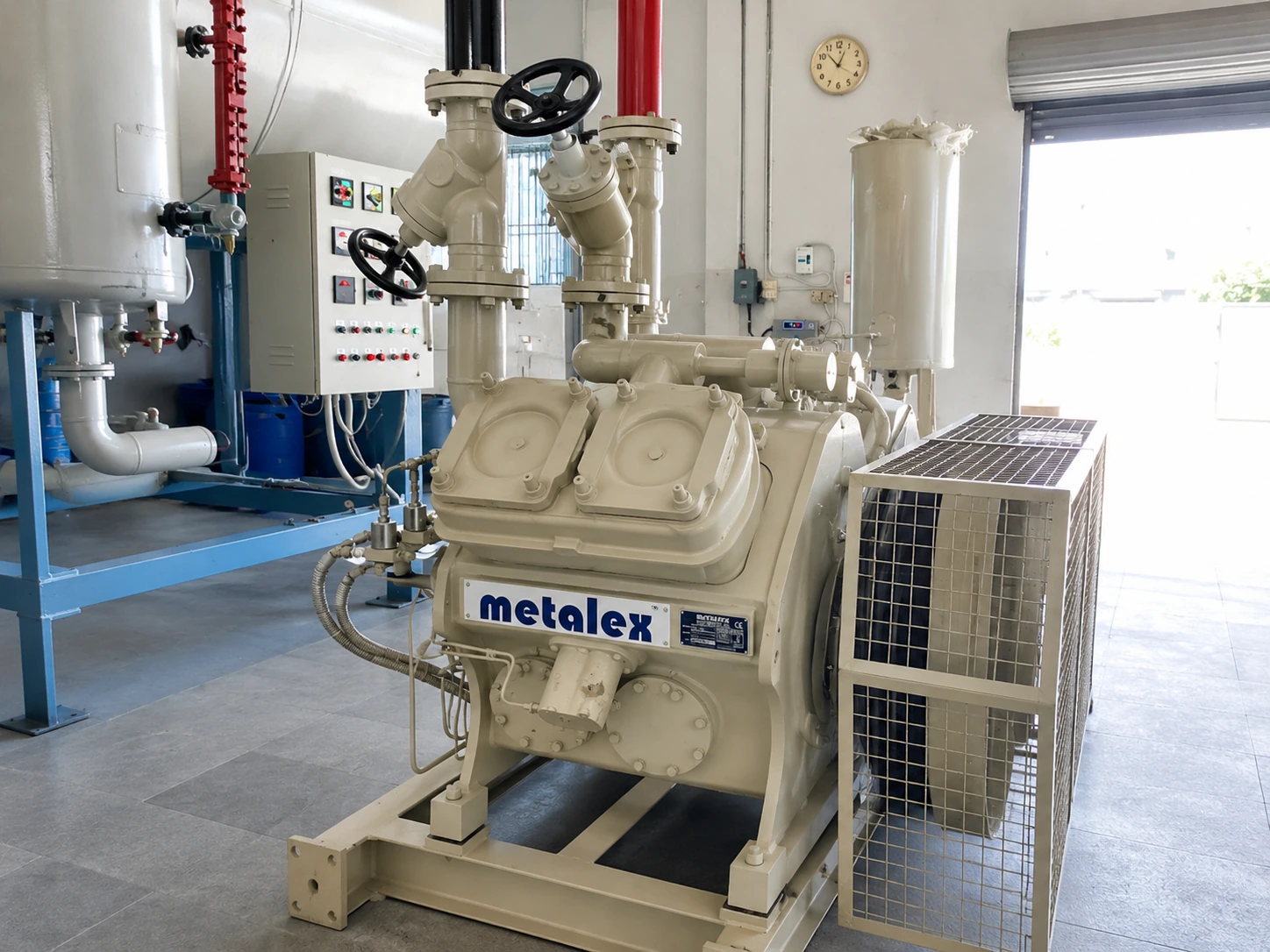
The Metalex MXT Series ammonia compressor is an air cooled reciprocating piston compressor range for NH3 / R717 industrial refrigeration. It is intended for applications such as cold storage, ice plants, dairies, food processing, seafood facilities and process cooling where dependable capacity, reduced compressor-cooling-water dependency and service access matter.
For buyers comparing an ammonia reciprocating compressor in India, model selection should start with the real refrigeration duty: required cooling capacity in kW or TR, evaporating temperature, condensing condition, load variation, operating hours and site utilities. A model number on its own does not define the correct compressor.
Metalex manufactures reciprocating ammonia piston compressors for industrial R717 refrigeration, including the air cooled MXT Series for higher-capacity single-stage duty.
- Air cooled, single-stage reciprocating ammonia compressor range for industrial refrigeration.
- MXT-400, MXT-600, MXT-800 and MXT-1000 cover 4 to 10 cylinders and 637 to 1592 m³/h swept volume at 1200 rpm.
- Final selection depends on refrigeration load, evaporating and condensing conditions, operating profile and installation requirements.
What a reciprocating ammonia compressor actually does
A reciprocating compressor uses pistons moving inside cylinders to draw in low pressure ammonia vapour and compress it to a higher pressure before the refrigerant rejects heat in the condenser. Real plant performance depends on suction condition, compression ratio, speed, capacity control, condensing temperature and the complete ammonia refrigeration system.
That is why NH3 compressor is only the beginning of the specification. A cold storage compressor running near 0°C evaporation is not doing the same job as a low temperature freezer compressor. The machine has to be selected against the actual operating point.
Why air cooled ammonia compressors are relevant
An air cooled reciprocating ammonia compressor can reduce dependence on compressor cooling water. That is useful where water hardness is high, treated water is difficult to maintain.
Metalex’s ISH air cooled compressor range is positioned for installations where water cooling is not preferred. Metalex also states that the ISH Series is suitable for high ambient conditions up to 50°C, subject to final project selection.
For higher capacity air cooled duty, the Metalex T Series is built around energy efficiency, reliability and serviceability. As one reference point, the MXT-800 T Series compressor is listed at 1098 kW / 312 TR at 0°C evaporation, 40°C condensing and 1200 rpm. Published ratings still need to be checked against the required duty.
MXT Series ammonia compressor models
The Metalex MXT Series, also referenced as the T Series, includes MXT-400, MXT-600, MXT-800 and MXT-1000. Published Metalex data gives the following quick technical reference at 1200 rpm:
These figures help with preliminary comparison, but ammonia compressor selection should be based on the required operating point. The largest swept volume is not automatically the best choice. Part-load behaviour, capacity control, peak pull-down demand and the expected minimum load all matter.
What data should be checked before compressor selection
Before selecting an air cooled ammonia compressor or industrial refrigeration compressor, prepare the operating data that determines real compressor performance:
- Application: cold storage, ice plant, dairy, food processing or process cooling
- Refrigerant: normally R717 ammonia for the duty discussed here
- Required cooling capacity in kW or TR
- Evaporating temperature
- Condensing temperature or expected ambient condition
- Required compressor speed / RPM and published swept-volume reference
- Stage requirement, suction condition and operating range
- Part-load requirement and capacity-control strategy
- Power supply and site utilities
- Daily operating hours, load variation and peak pull-down demand
- Project location and machinery room layout
- Future expansion, if already planned
This information is useful for cold storage compressor sizing, replacement enquiries, plant expansion and new turnkey refrigeration projects. Final capacity should be confirmed from the applicable performance data at the project operating condition.
Installation matters as much as the compressor
Ammonia compressor installation has a direct effect on reliability and serviceability. A good compressor can perform badly in a poor installation. Foundation and equipment supports must suit the machine and drive arrangement. Piping should not place avoidable strain on compressor connections. Suction and discharge lines, oil management, valves, instrumentation and safety devices need to be treated as one system. Alignment and service clearance should be checked before commissioning.
Ammonia machinery rooms require disciplined safety planning, including correct piping, foundations, leak testing, ventilation, access and service clearances. These requirements should be reviewed against the applicable refrigeration and local safety codes for the project location.
Metalex can support the compressor with industrial refrigeration plant equipment, evaporative condensers and project support.
Where reciprocating ammonia compressors are used
Cold storage: Correct compressor selection supports stable room temperatures across chilled, frozen and multi room facilities. See Metalex cold storage solutions.
Ice plants: Block, tube and flake ice production needs dependable refrigeration duty and careful matching between compressor capacity and daily ice output. Explore turnkey ice factory projects.
Dairy plants: Milk chilling, cold rooms, process cooling and ice cream production create changing refrigeration loads. See dairy refrigeration and dairy project engineering.
Food and seafood processing: Chilling, freezing and cold storage can run on one industrial refrigeration platform when the plant is engineered around the process. See food processing refrigeration and seafood refrigeration.
Energy efficiency is a system result
An energy efficient ammonia compressor is useful only when the refrigeration system lets it operate efficiently. High condensing pressure, incorrect suction conditions, poor capacity control, unnecessary pressure drops or badly matched part-load operation can increase power use even when the compressor itself is correctly engineered.
For the MXT Series, efficiency should be reviewed with the actual refrigeration load, compressor speed, cylinder-based capacity control, condenser performance, evaporator duty and operating temperatures. This system-level view is more useful than comparing a single headline capacity figure and also gives a better basis for evaluating long-term operating cost.
Maintenance and long term reliability
Reciprocating compressors remain attractive because the machine can be inspected and serviced. Metalex T Series references highlight service-focused features including capacity control by cylinder, minimized oil carryover and a large screw-on oil filter. In operation, keep logs, watch suction and discharge pressures, check oil condition, investigate unusual vibration or temperature changes and follow the correct maintenance interval.
Metalex provides service and maintenance support, and project enquiries can be sent through the Metalex contact page.
Conclusion
The best reciprocating ammonia compressor is not the one with the biggest capacity figure. It is the machine that matches the refrigeration load, site utilities, operating temperature and maintenance plan.
For an air cooled ammonia compressor, cold storage compressor or complete ammonia refrigeration project, start with the duty data and select the compressor around the system. Review the Metalex ammonia compressor range or discuss a complete project through Refrigeration Projects.
MXT Series ammonia compressor FAQ
It is a piston type refrigeration compressor that compresses ammonia vapour in an industrial refrigeration cycle. It is commonly used in cold storage, ice plants, dairy, food processing and process cooling.
It reduces dependence on compressor cooling water, which can simplify utilities where water quality or treatment availability is a concern. Final suitability still depends on ambient temperature and project duty.
Start with cooling load, evaporating temperature, condensing condition, refrigerant, operating hours and load variation. Select the compressor from verified performance data for that operating point.
Metalex supplies ammonia compressors and related plant equipment, while its project division supports cold storage, ice factory, dairy, seafood and other industrial refrigeration project discussions from concept through commissioning support.
Use MXT-400, MXT-600, MXT-800 and MXT-1000 as model references, then confirm the final machine from the required kW or TR load, evaporating temperature, condensing condition, load profile, compressor speed and project installation details. Do not select only by cylinder count or swept volume.
Planning an ammonia refrigeration project?
Share the application, capacity, evaporating temperature, condensing condition, project location and utility details for a proper compressor review.