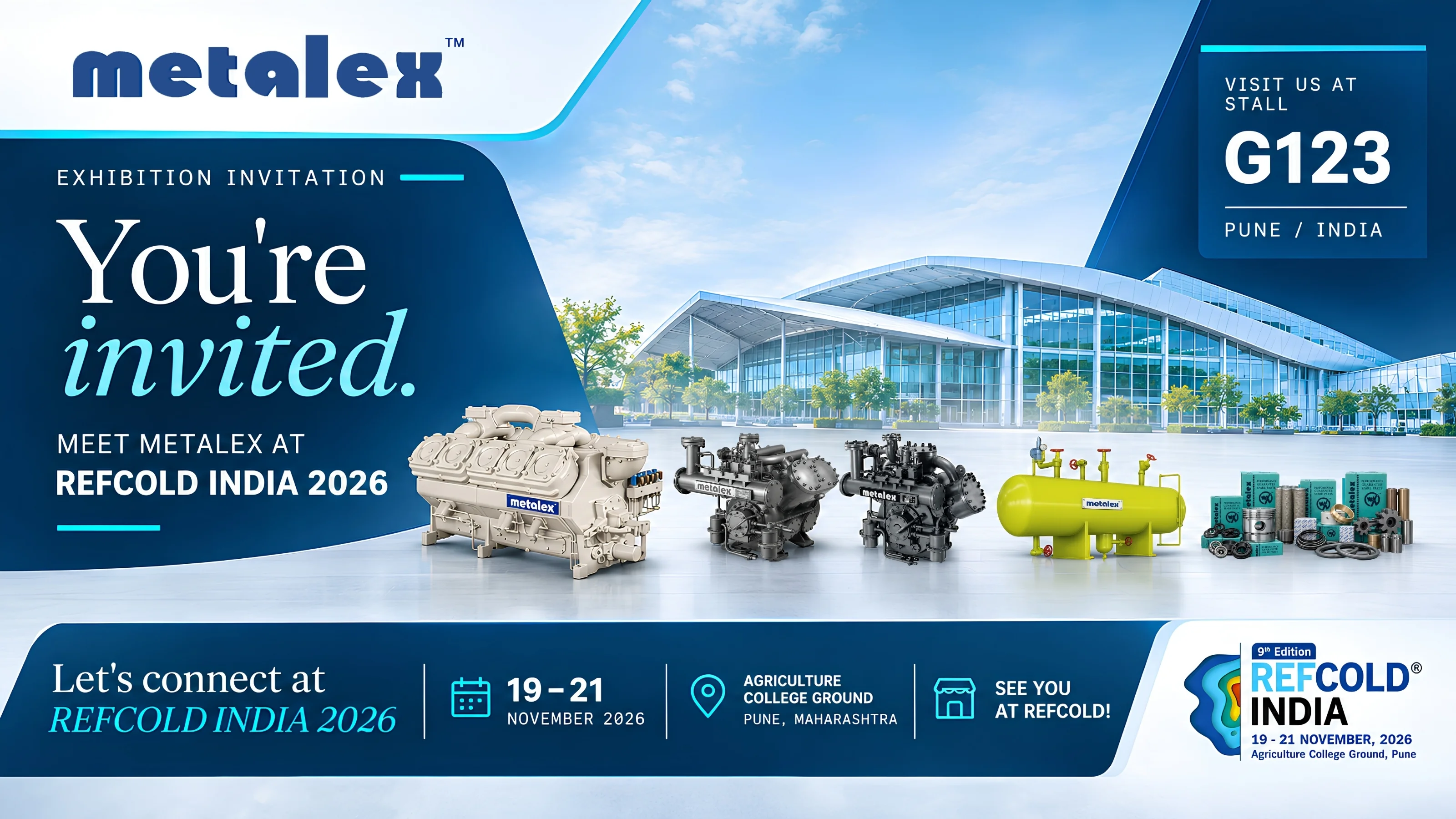
Industrial refrigeration is entering a stage where plant owners are asking better questions. How can ammonia systems deliver high efficiency with practical serviceability? How can operators reduce unnecessary energy use? How can cold stores preserve product quality for longer? How can refrigerant charge be reduced without compromising cooling performance? And how can instrumentation, pumping, secondary fluids and controls work as one coordinated system rather than isolated components? At REFCOLD India 2026, Metalex Cryogenics will bring these conversations together at Stall G123.
For engineers, consultants, cold-storage owners, food processors, dairies, seafood processors, pharmaceutical plants, ice plants, EPC companies and investors, the Metalex stand is intended to be more than a product display. It is a place to discuss complete refrigeration architecture: compression, pumping, liquid management, sensing, pressure equipment, secondary cooling, controlled atmosphere storage, project engineering and the long-term service support that keeps industrial cooling running after commissioning.
REFCOLD India 2026: where the cold-chain industry meets in Pune
REFCOLD India 2026 will be held from 19 to 21 November 2026 at Agriculture College Ground, Pune, Maharashtra. The event positions itself as South Asia's premier refrigeration and cold-chain exhibition, bringing together refrigeration manufacturers, system integrators, consultants, end users, cold-chain specialists, technology providers and policy stakeholders.
The scale of the event matters. REFCOLD's current event information highlights more than 200 exhibitors, around 11,500 square metres of exhibition area and an expected audience of more than 20,000 visitors. Its conference programme also includes natural refrigerants, dairy, food processing, Maharashtra crop storage, industrial refrigeration for chemical, pharma and brewery applications, and the digital cold chain. That mix makes the exhibition especially relevant for serious project conversations rather than simple catalogue browsing.
Why Metalex deserves a serious conversation at REFCOLD
Metalex Cryogenics has been connected with industrial refrigeration engineering since 1968. That gives the company something difficult to manufacture quickly: accumulated field experience. Compressors can be designed on a drawing board, but understanding what happens after years of operation in Indian ambient conditions, varying water quality, demanding duty cycles and maintenance realities comes from long-term exposure to actual plants.
The Metalex story is broader than a single compressor range. The company's engineering timeline and recognition history records operations beginning in 1968, pressure-vessel fabrication starting in 1969, the energy-efficient T-Series launching in 2007 and an international supply footprint that had reached 100 countries by 2012. Today Metalex presents itself as a three-generation refrigeration company combining engineering, manufacturing, turnkey execution, commissioning support, genuine spare parts and service.
That combination is one of Metalex's strongest advantages. A buyer can discuss a complete industrial refrigeration portfolio instead of trying to coordinate unrelated components from multiple suppliers without a clear system owner. Metalex covers reciprocating ammonia compressors, compressor packages, pressure vessels, valves, ice-making systems, controls, project engineering and plant support, while also connecting customers with specialised global refrigeration technologies through its partner technology portfolio.
“The real value of an industrial refrigeration company is not only the equipment it can supply. It is the confidence that the system can be engineered, commissioned, serviced and supported for years after the first start-up.”Metalex Engineering Team
Built around Indian industrial operating conditions
Metalex's engineering approach is especially relevant to Indian cold-chain projects where equipment must work through high ambient temperatures, long operating hours, power-cost pressure, water-quality constraints and constant uptime expectations. A strong project discussion therefore begins with the real application: product temperature, evaporating condition, condensing condition, load profile, refrigerant circulation, ambient temperature, utility availability, maintenance access and expansion plans.
Visitors planning a new cold store, dairy, food-processing line, ice plant, seafood facility, pharmaceutical plant or process-cooling installation can explore the Metalex industrial refrigeration ecosystem, review the product range, understand the company's engineering background and continue the conversation through technical support or a project enquiry.
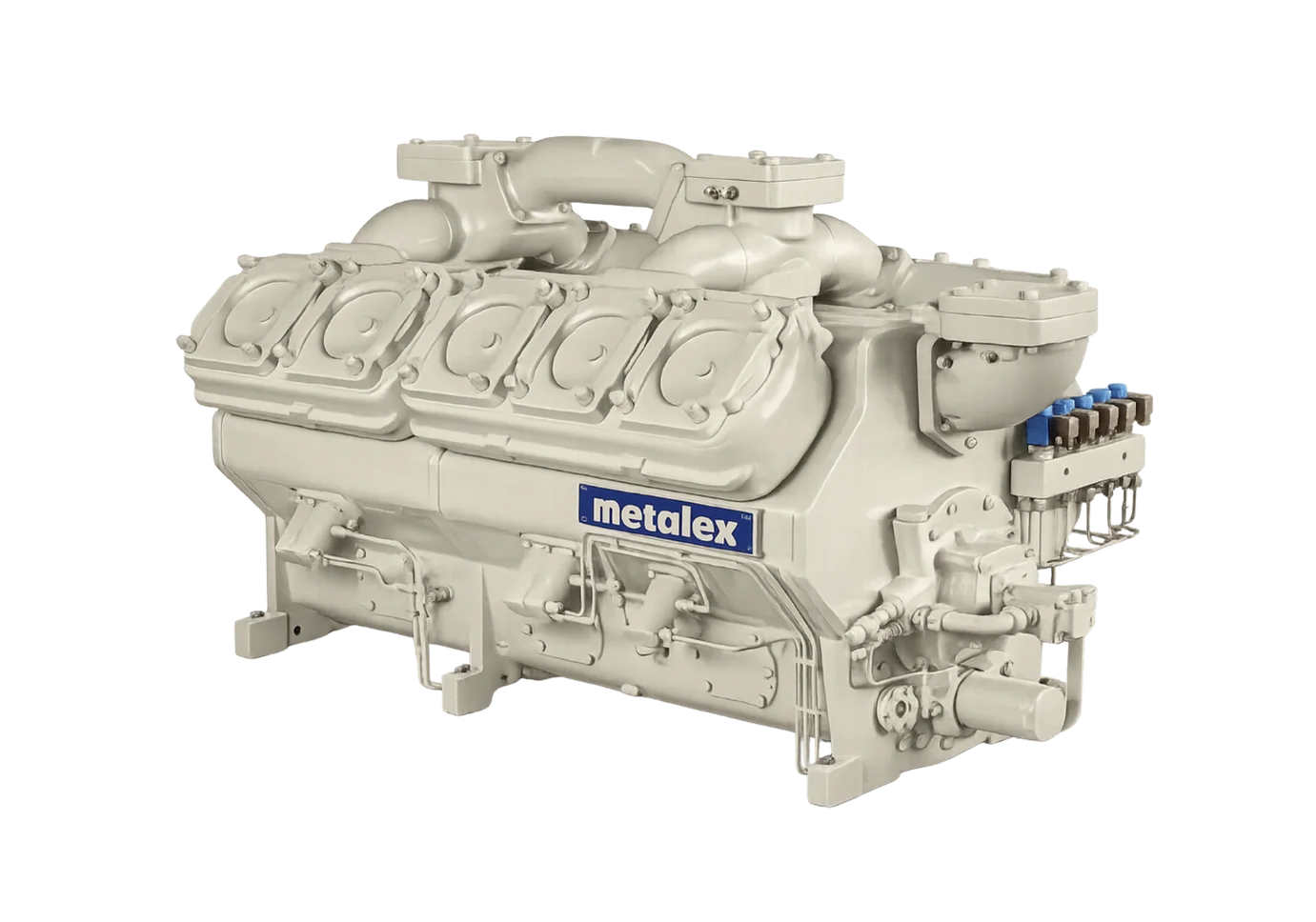
Metalex T Series 10-cylinder: high-capacity air-cooled ammonia compression
One of the important Metalex technologies to discuss at REFCOLD is the T Series air-cooled reciprocating ammonia compressor range. The range was developed around a practical industrial requirement: dependable ammonia compression without the need for compressor water cooling.
For large-duty projects, the 10-cylinder T Series configuration represents the high-capacity end of the range. Official Metalex technical information lists a 1592 m³/h swept volume, 10 cylinders, 160 mm bore, 110 mm stroke and operation up to 1200 rpm. The reference data published by Metalex is based on ammonia R-717 duty.
Why the T Series approach matters
Air-cooled compressor construction can be highly relevant where compressor water cooling is undesirable or where water quality creates maintenance concerns. The T Series uses a welded compressor housing, temperature-isolated cylinder heads, heavy-duty axial roller bearings, capacity-control steps per cylinder, speed-control suitability, low-noise design, minimised oil carryover and a service-focused oil filtration arrangement.
- No compressor water cooling required: useful where water availability or quality is a design concern.
- Capacity control: helps match compressor output to changing refrigeration demand.
- Industrial NH3 duty: designed around ammonia R-717 refrigeration applications.
- Service-focused construction: intended to support dependable maintenance and long equipment life.
- Broad application fit: cold storage, ice plants, dairy, food processing, seafood, beverage and process cooling.
Final compressor selection should never be based only on nominal capacity. Metalex engineers can review suction condition, condensing temperature, refrigeration load, ambient condition, motor requirement, capacity-control strategy and plant layout before recommending the correct configuration. Visitors can also read the Metalex guide to reciprocating ammonia compressor selection.
TH. WITT: precision refrigerant pumping for industrial systems
The REFCOLD invitation also highlights TH. WITT refrigeration technology through Metalex. In pumped industrial refrigeration systems, the pump is not a minor accessory. Stable liquid delivery affects evaporator performance, circulation rate, system response and overall reliability.
TH. WITT refrigerant pumps are purpose-designed for refrigeration duty. The portfolio includes open-type GP pumps and hermetic HRP pumps. The WITT GP range uses a service-friendly flanged motor arrangement, while the WITT HRP range uses an integrated canned motor for hermetically sealed refrigerant pumping.
For consultants and plant engineers, the important point is correct pump selection against the actual refrigerant, circulation rate, pressure head, evaporating condition and piping losses. Metalex can help connect pump selection with the larger ammonia system rather than treating the pump as an isolated purchase.
HB Products: precise sensing for safer, more efficient refrigeration
Modern refrigeration plants need reliable information before they can be controlled efficiently. Through HB Products technology, Metalex can support key sensing and protection points throughout the refrigeration system.
HB Products develops sensors and control components for industrial and commercial refrigeration and heat-pump systems. Its portfolio covers liquid-level measurement, oil management, pressure, temperature, vapour quality, defrost control and leakage detection. Products highlighted in the Metalex REFCOLD invitation include liquid-level sensing, compressor-protection sensing and oil-level control.
This matters because efficiency is often limited by what the control system cannot see. Correct level measurement can protect vessels and improve refrigerant management. Compressor-protection sensing can help identify harmful liquid conditions. Oil-level control supports compressor reliability. Vapour-quality and defrost sensing can provide better information for energy-conscious control.
KRAHN Specialty Fluids and CRANE Temper: a major step forward in secondary refrigeration
One of the most important technology discussions at the Metalex stand will be KRAHN Specialty Fluids. Metalex connects Indian refrigeration projects with KRAHN's specialised knowledge in heat-transfer fluids, particularly CRANE Temper for industrial refrigeration.
This matters because the secondary fluid can quietly determine a large part of the hydraulic and thermal performance of an indirect refrigeration system. Engineers often focus intensely on the compressor, condenser and evaporator, then treat the secondary fluid as a simple consumable. In reality, its viscosity, density, specific heat, thermal conductivity, corrosion behaviour and freezing point directly influence pump size, pipe pressure drop, heat-exchanger performance and energy use.
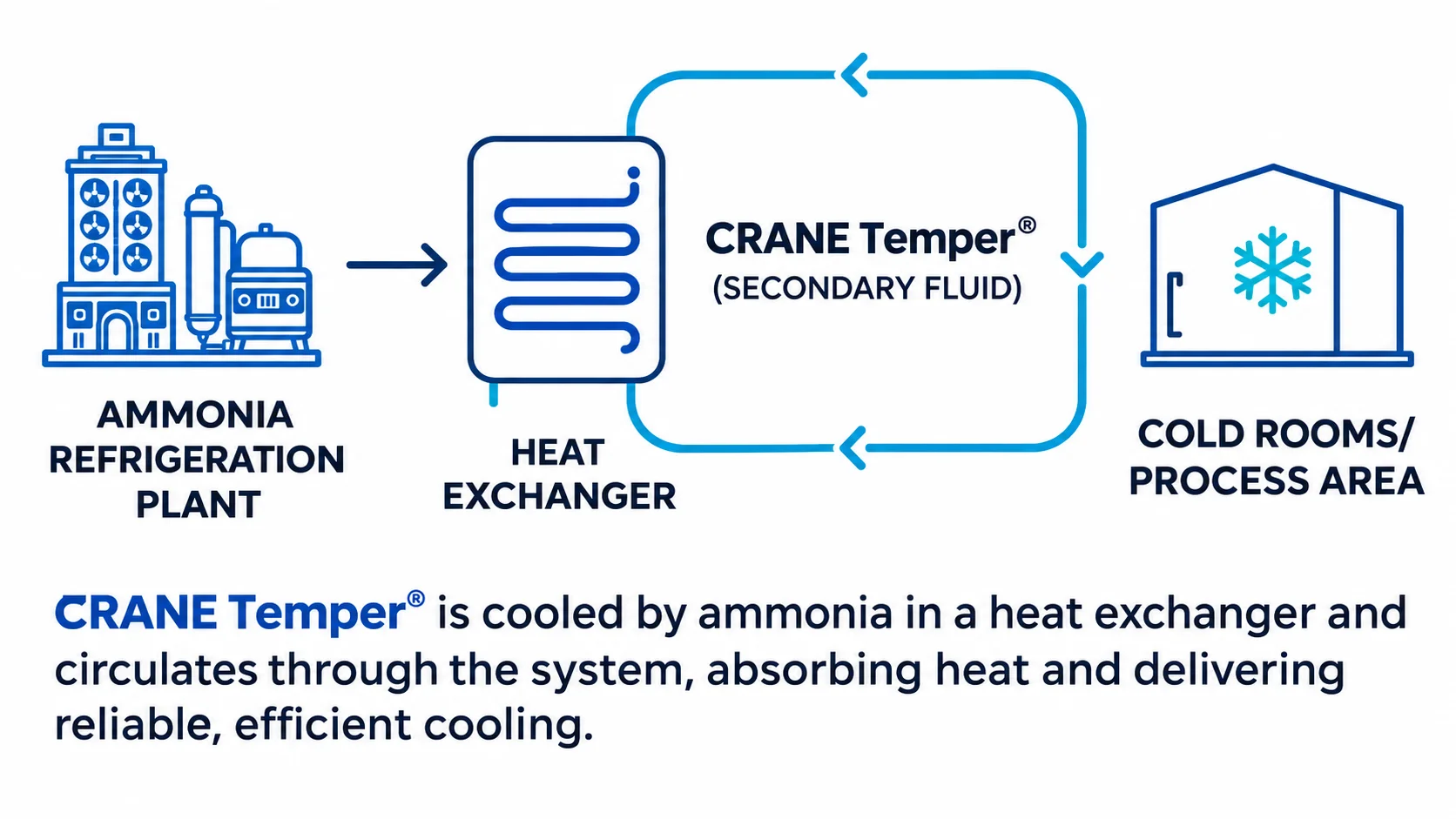
What is CRANE Temper?
KRAHN Specialty Fluids describes CRANE Temper as a ready-mixed, non-toxic, organic salt-based heat-transfer fluid for secondary refrigeration. The formulation is based primarily on potassium salts and includes an advanced corrosion-inhibitor package. It is designed to combine low viscosity with useful specific heat capacity and thermal conductivity, especially at refrigeration temperatures where conventional glycol mixtures can become increasingly viscous.
The current CRANE Temper technical data lists seven grades: T-10, T-15, T-20, T-30, T-40, T-55 and T-60. These grades are supplied ready to use and cover freezing-point requirements from approximately -10°C to -60°C.
Why low viscosity matters so much
Every metre of pipe creates resistance. Every valve, bend, strainer and heat exchanger adds pressure drop. The more viscous the circulating fluid becomes, the more pumping energy is required to move the design flow through the system. At low temperatures this difference can become significant.
CRANE Temper's low viscosity is therefore not simply a fluid specification. It can influence the complete system design. Lower hydraulic resistance may support smaller pumps, lower pump input, reduced pressure losses and more flexible pipe sizing when compared under equivalent design conditions with higher-viscosity alternatives. Its thermal conductivity and specific heat also affect how efficiently cooling capacity is transported from the primary refrigeration plant to the cold room or process.
CRANE Temper T-10 to T-60: choose by actual design temperature
The correct grade depends on the minimum fluid temperature and required freeze protection. Selection should include a practical safety margin while avoiding unnecessary concentration. Using a colder grade than required changes density, viscosity and heat-transfer performance, so the best selection is an engineering decision rather than a simple “lower is better” choice.
- T-10: for secondary cooling where approximately -10°C freeze protection is suitable.
- T-15: for moderately lower-temperature loops and food/logistics applications.
- T-20: for colder secondary systems requiring additional freeze margin.
- T-30: a strong fit for many frozen-food and industrial low-temperature applications.
- T-40: for demanding low-temperature refrigeration duty.
- T-55 and T-60: for very-low-temperature secondary refrigeration where extreme freeze protection is required.
Why CRANE Temper is attractive for food and cold-chain applications
KRAHN highlights CRANE Temper as non-toxic, readily biodegradable, chemically stable and suitable for food-industry refrigeration. The product is supplied ready mixed, helping avoid concentration errors that can occur when a heat-transfer fluid is mixed on site. Current KRAHN documentation also lists advanced inhibitor technology for corrosion protection and certification references for food-related heat-transfer applications.
For distribution centres, cold stores, dairies, meat-processing plants, beverage facilities and industrial food operations, this combination is valuable because refrigeration performance and operational safety must coexist. The fluid should circulate efficiently, remain stable during operation and fit the hygiene and environmental expectations of the application.
CRANE Temper with ammonia: less NH3 in occupied areas
One of the strongest applications is an indirect ammonia refrigeration system. Ammonia can remain concentrated within the primary machinery circuit, while CRANE Temper carries cooling through the secondary loop to cold rooms or process areas. This architecture can reduce the amount of ammonia circulating through occupied areas and can make future distribution-loop modifications easier to manage.
KRAHN's refrigeration references include food-production and refrigerated-logistics facilities using ammonia as the primary refrigerant with CRANE Temper as the secondary fluid. The engineering benefit is not that the secondary fluid replaces good ammonia design. Rather, it gives the designer another system architecture to consider when charge reduction, distribution flexibility and secondary-loop efficiency are project priorities.
Engineering CRANE Temper correctly
A high-performance fluid still needs a correctly designed hydraulic circuit. Metalex can help project teams evaluate the secondary loop together with the primary refrigeration plant. Useful inputs include required supply and return temperature, total cooling load, pipe length, elevation, number of branches, heat-exchanger duty, air-cooler pressure drop, pump redundancy, expansion volume, control method and expected operating hours.
- correct CRANE Temper grade and freeze-protection margin;
- secondary-fluid flow rate and temperature difference;
- pump duty, redundancy and expected pumping energy;
- pipe diameter and total system pressure drop;
- plate heat-exchanger selection and approach temperature;
- expansion-vessel sizing and air removal;
- material compatibility and corrosion protection;
- insulation requirements and condensation control;
- commissioning, filling, labelling and fluid-maintenance procedures.
For teams comparing CRANE Temper with glycol, KRAHN also maintains a detailed CRANE Temper FAQ and application guidance. The most meaningful comparison should be carried out at the actual operating temperature, because that is where viscosity and heat-transfer differences become relevant to system energy use.
Why Stall G123 is worth putting on your REFCOLD route
Metalex is bringing together several layers of industrial refrigeration engineering in one place. That matters because the strongest cold-chain projects are rarely built around a single machine. They are built around an integrated system where every component has a defined role and every design decision is connected to operating cost, product quality, safety and maintainability.
- For cold-storage owners: discuss complete ammonia refrigeration, secondary cooling, controls and future expansion.
- For food processors: evaluate reliable compression, pumps, sensing and food-suitable heat-transfer-fluid options.
- For fruit and vegetable projects: discuss refrigeration load, temperature stability, humidity considerations, secondary cooling and future expansion with the Metalex engineering team.
- For consultants and EPC teams: review T Series compressor duty, WITT pumping, HB sensing and KRAHN fluid data.
- For existing plants: discuss modernisation, energy performance, genuine spares and Metalex service support.
- For new investors: start with product, capacity, temperature, site and utility information before equipment is finalised.
The most useful way to prepare for a meeting is to bring your design conditions. If you have a live project, carry the product to be cooled, target temperature, incoming product temperature, daily throughput, room size, estimated refrigeration load, existing refrigerant, ambient site conditions, water availability, electrical supply and any plant-layout drawing. The more real information you bring, the more useful the engineering discussion becomes.
Frequently asked questions
Quick answers for visitors planning to meet Metalex at REFCOLD India 2026.
Metalex will be at Stall G123, 19–21 November 2026, at Agriculture College Ground, Pune.
You can discuss compressors, ammonia plant engineering, WITT pumps, HB Products sensing, KRAHN CRANE Temper, spares and long-term service with the Metalex team.
It is a high-capacity air-cooled ammonia compressor configuration with 1592 m³/h swept volume, 10 cylinders and up to 1200 rpm. Final selection depends on the actual duty point.
Metalex traces its engineering journey to 1968, with decades of experience in industrial ammonia refrigeration, equipment manufacturing and project support.
Metalex can help evaluate TH. WITT GP and HRP refrigerant pumps as part of the complete ammonia refrigeration system.
CRANE Temper is a secondary heat-transfer fluid for indirect refrigeration, available in grades from T-10 to T-60 for different low-temperature duties.
Yes. Ammonia can remain in the primary circuit while CRANE Temper circulates in the secondary loop through a heat exchanger. The system must be engineered for the actual load and temperature.
Yes. Metalex supports engineering review, equipment selection, manufacturing, commissioning assistance, genuine spares and service support.
Come with a project. Leave with a clearer refrigeration direction.
REFCOLD India 2026 is a strong opportunity to compare technologies, but the most valuable outcome is not collecting the largest number of brochures. It is finding the right engineering partners for the complete life of the plant. Metalex brings nearly six decades of refrigeration experience, Indian manufacturing knowledge, project engineering, a broad ammonia refrigeration portfolio and access to specialised technologies from respected international companies.
At Stall G123, visitors can discuss the Metalex T Series, TH. WITT refrigerant pumps, HB Products sensors and controls, and the detailed secondary-cooling potential of KRAHN CRANE Temper.
For plant owners who value efficiency, reliability, maintainability and long-term technical support, that combination makes Metalex a conversation worth prioritising at REFCOLD India 2026.