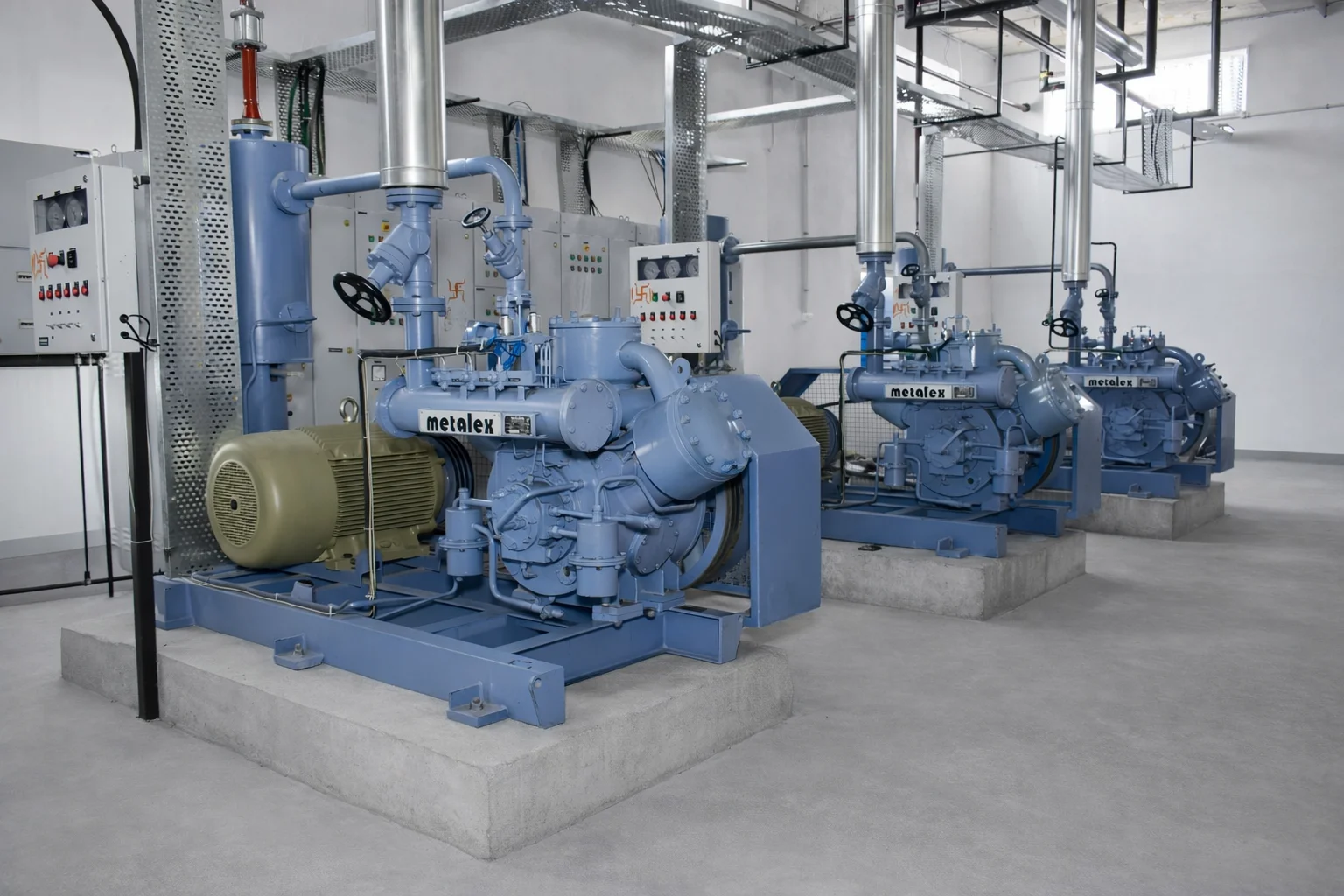
An ammonia piston compressor capacity calculation starts with the refrigeration duty a facility must deliver, not simply the size of its building or the number of compressor cylinders. For a cold storage project, the engineer first establishes the cooling load, converts it into TR or kW, and then matches that duty with an ammonia piston compressor rated for the required evaporating and condensing temperatures.
Calculate the design refrigeration load in kilowatts, then use TR = cooling capacity (kW) ÷ 3.51685. For example, a design load of 175.84 kW equals approximately 50 TR. Next confirm the ammonia refrigerant, evaporating temperature, condensing temperature, compressor speed and manufacturer performance chart. The final model must deliver the required net refrigeration duty at those actual design conditions.
What does ammonia piston compressor capacity mean?
In industrial ammonia refrigeration, compressor capacity normally refers to the refrigeration effect or cooling capacity available at specified operating conditions. This is commonly expressed as kW of refrigeration or tons of refrigeration (TR). It is not the same as compressor shaft power or electricity consumption. That distinction helps engineers compare ammonia compressor specifications accurately.
A reciprocating ammonia compressor compresses R717 refrigerant vapour within an engineered refrigeration cycle. Its usable refrigeration capacity depends on refrigerant mass flow and refrigeration effect, which are influenced by suction conditions, discharge conditions, compressor construction and operating speed.
Ammonia compressor capacity calculation formula in TR and kW
The conversion between cooling capacity and tons of refrigeration is a useful starting point for comparing cold storage compressor requirements.
Cooling capacity (kW) = TR × 3.51685
Capacity (TR) = Cooling capacity (kW) ÷ 3.51685
These formulas convert units of refrigeration capacity. They do not calculate the electrical input power of an ammonia piston compressor.
| Required cooling duty | Equivalent refrigeration capacity | Typical use of the figure |
|---|---|---|
| 25 TR | 87.92 kW | Initial design duty comparison |
| 50 TR | 175.84 kW | Illustrative cold storage sizing example |
| 75 TR | 263.76 kW | Plant capacity planning |
| 100 TR | 351.69 kW | Equipment shortlist and duty confirmation |
For a more complete thermodynamic calculation, Q₀ = ṁ × (h₁ − h₄), where Q₀ is cooling capacity in kW, ṁ is refrigerant mass flow in kg/s, and the enthalpy difference is in kJ/kg. The enthalpy states must correspond to the chosen R717 cycle, including its evaporating, condensing and liquid supply conditions. Qualified engineers establish these values using suitable refrigerant property data and the detailed system design.
Step 1: establish the actual cold storage refrigeration load
Before ammonia compressor sizing, calculate how much heat the refrigeration system must remove. Storage volume or commodity tonnage alone does not provide an accurate TR requirement. A cold storage cooling load can include transmission through insulated walls and roof, incoming product pull down, respiration where applicable, air infiltration, internal heat from lights and equipment, people, defrost and other project specific loads.
Product type, entry temperature, holding temperature, daily throughput, loading frequency and operating hours must also be established. A frozen product store, chilled produce facility and turnkey cold storage project can therefore have very different refrigeration duties at similar storage capacities.
Step 2: convert a 50 TR design requirement to kW
For a cold storage project with a confirmed refrigeration demand of 50 TR, the cooling capacity is 50 × 3.51685 = 175.84 kW. This gives the required refrigeration output, not a 175.84 kW motor rating. An ammonia piston compressor should be chosen from validated capacity data at the proposed operating temperatures. This keeps the initial calculation useful when moving from concept design to equipment specification.
Step 3: define evaporating and condensing temperatures
Evaporating temperature is related to the refrigeration temperature level and the evaporator approach. Condensing temperature reflects the heat rejection arrangement and design conditions. Both influence refrigeration capacity and shaft power. Therefore an ammonia compressor capacity chart must always be read with the corresponding temperature conditions, refrigerant and compressor speed.
For example, a Metalex published model rating at 0°C evaporating and 40°C condensing must not be presented as the capacity of that model at a substantially lower cold room evaporating temperature. Use the appropriate manufacturer performance selection for each actual refrigeration duty.
Step 4: understand how RPM and swept volume relate to capacity
RPM measures crankshaft revolutions per minute. For a conventional single acting reciprocating compressor, the theoretical swept volume rate can be expressed as V̇s = (πD²/4) × L × z × N × 60, where D is cylinder bore in metres, L is stroke in metres, z is the number of working cylinders and N is RPM. The result is cubic metres per hour, assuming one suction displacement event per cylinder per revolution.
Swept volume is a geometric displacement measure, not actual refrigeration capacity. Volumetric efficiency, suction vapour density, refrigerant properties, operating temperatures and model specific performance determine delivered refrigerant flow and cooling duty. RPM selection must remain within the manufacturer's permitted speed range and drive arrangement.
If a compressor theoretically displaces 136 m³/h at 1000 RPM, its geometric displacement at 800 RPM would be about 108.8 m³/h under the same mechanical arrangement. This mathematical illustration does not mean the rated TR or kW changes by exactly the same percentage.
Step 5: distinguish TR, refrigeration kW and compressor power
Three numbers appear frequently in compressor proposals. TR is refrigeration capacity. kW cooling is the same thermal output expressed in SI units. kW shaft power (sometimes BkW) is mechanical power required at the compressor shaft at the stated conditions. Electrical input also depends on motor and drive efficiencies. For accurate project energy planning, use the confirmed operating data and complete plant power balance.
Metalex ammonia piston compressor capacity selection by series
Metalex offers industrial compressor options for different refrigeration applications and plant arrangements. The MX Series provides water cooled reciprocating compressors; the IS Series includes air cooled ammonia compressor configurations; and the MXT Series provides further air cooled configurations and capacity choices. An informed selection starts with the plant's actual cooling duty, site utilities, temperature levels and required operating profile.
MX Series
Water cooled R717 reciprocating compressor options for industrial refrigeration. Explore model specific technical specifications and project duty selection.
IS Series
Air cooled reciprocating compressor options suitable for review where the compressor cooling arrangement should avoid dedicated cooling water.
MXT Series
Air cooled ammonia piston compressor configurations with published technical features and model specific refrigeration ratings.
A real Metalex model rating: MX 100
The Metalex MX 100 is a water cooled, single stage, one cylinder reciprocating compressor. Its published ammonia reference capacity is 110.40 kW, or 31.38 TR, with 24.90 BkW shaft power at 1000 RPM, 0°C evaporation and 40°C condensing temperature. This published example demonstrates why a meaningful compressor capacity figure always includes its rating conditions.
For another example, Metalex MXT 400 publishes a reference cooling capacity of 549 kW / 156 TR at 0°C evaporation and 40°C condensing, with four cylinders, 637 m³/h swept volume and a maximum speed of 1200 RPM. These are reference data for distinct models, not interchangeable figures for different evaporating temperatures or compressor speeds.
When should single stage and two stage configurations be evaluated?
Single stage and two stage arrangements have different application envelopes. Evaporating temperature, condensing temperature, pressure ratio, intended temperature level and available compressor configurations help determine which option is suitable. The final arrangement should be checked against the Metalex performance information for the proposed installation. This is particularly important in lower temperature cold storage and freezing applications.
Applications requiring accurate R717 compressor sizing
Careful ammonia piston compressor sizing supports cold storage, dairy refrigeration, food processing, ice manufacturing, seafood processing, beverage facilities and process cooling installations. Each application has a different load profile and temperature target. Explore the wider Metalex industrial refrigeration applications to connect compressor selection with the intended process.
Information to share for a Metalex compressor selection
| Project information | Why it helps with sizing |
|---|---|
| Application and stored commodity | Defines product cooling requirements and temperature range |
| Calculated cooling duty in TR or kW | Sets the required refrigeration output |
| Evaporating and condensing temperatures | Establishes the compressor rating condition |
| Cold room temperature, throughput and operating hours | Defines the design duty and load profile |
| Site ambient and available utilities | Helps select the appropriate cooling arrangement |
| Preferred duty configuration and redundancy approach | Supports project specific capacity and equipment planning |
From cooling load calculation to a well matched Metalex compressor
A useful ammonia piston compressor capacity calculation links the cooling load to a verified refrigeration duty, converts TR and kW correctly, and accounts for evaporating temperature, condensing temperature and RPM. Metalex's MX, IS and MXT Series provide a practical product portfolio to explore once those design inputs are known. With an application specific selection, plant owners and engineering teams can move confidently from preliminary calculations to an informed compressor enquiry.
Get an ammonia piston compressor selection for your project
Share your calculated TR or kW, evaporating and condensing temperatures, application, site location and operating hours. The Metalex engineering team can review suitable compressor options and provide a project specific selection.
Get QuotesAmmonia piston compressor capacity calculation FAQ
Determine the required refrigeration duty in kW, then divide by 3.51685. Use the selected evaporating and condensing conditions to verify that a compressor can deliver the resulting TR.
One ton of refrigeration is approximately 3.51685 kW of cooling capacity. This is a thermal capacity conversion, not a compressor motor power conversion.
Cooling capacity in kW is the rate of heat removed by the refrigeration system. Motor electrical input kW is the energy required to drive the compressor and depends on its shaft power, motor efficiency and operating condition.
No fixed TR value can be derived from storage tonnage alone. Product type, incoming temperature, holding temperature, daily loading, insulation, room conditions and operating time determine the actual refrigeration load.
RPM affects theoretical piston displacement and refrigerant flow potential. Delivered cooling capacity additionally depends on volumetric efficiency, refrigerant suction conditions and model specific performance.
Swept volume is the theoretical volume displaced by the compressor pistons over a defined time. It can be calculated from bore, stroke, working cylinder count and RPM, but is not itself the refrigeration capacity in TR.
They define the compression operating condition and influence refrigerant flow, refrigeration capacity and shaft power. Metalex selection should use performance figures for the actual project temperatures.
The Metalex MX 100 lists 110.40 kW / 31.38 TR at 1000 RPM, 0°C evaporating and 40°C condensing, with 24.90 BkW shaft power at those conditions.
Metalex offers MX water cooled, IS air cooled and MXT air cooled reciprocating compressor ranges. Appropriate models are selected against duty temperatures, required TR, site utilities and project conditions.
Provide refrigeration load in TR or kW, ammonia refrigerant, design evaporating and condensing temperatures, operating hours, ambient conditions, application and site location. Then use the Get Quotes enquiry.