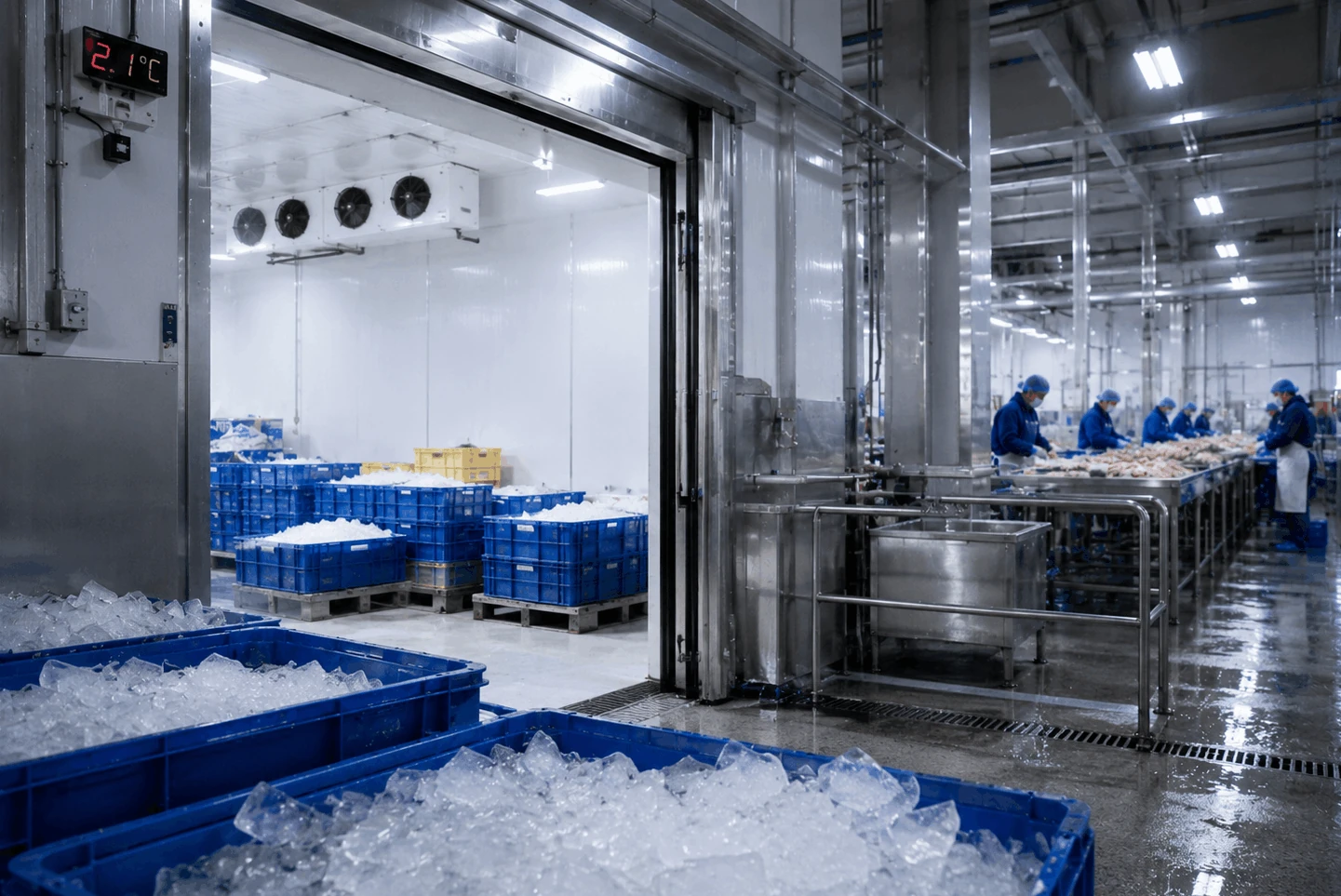
Seafood refrigeration does not begin inside a frozen store. By the time fish or shrimp reaches that room, the first quality decisions have already been made. Landing temperature, icing, receiving time, processing conditions, freezing cycle and final storage all work as one chain.
A seafood refrigeration system should be designed around product movement, not one room temperature. A harbour, a shrimp line and an export frozen store impose different loads. Metalex Cryogenics connects ice production, process cooling, freezing and frozen storage as one operating system.
Seafood refrigeration begins before the freezer
Fresh catch carries heat into the plant. Every delay before effective chilling gives that heat more time to work against product quality. The first question is not simply how many tons of refrigeration are required. Ask how warm the product is on arrival, how much arrives at once, how long it waits, what ice is used and what temperature must be reached before processing.
At landing centres, ice production can dominate the design. In a seafood processing plant, room loads, wash water, doors and the freezer cycle enter the calculation. At the export end, seafood cold storage, dock traffic and reefer dispatch matter just as much.
Where a two stage ammonia compressor earns its place
Low temperature seafood freezing can impose a demanding pressure ratio on the compressor. When evaporating conditions become sufficiently low, two stage compression can be a more appropriate arrangement than forcing one stage to cover the entire lift. The decision depends on evaporating temperature, condensing condition, capacity, operating hours, ambient temperature and system architecture.
Metalex offers MX Series water cooled ammonia compressors with single stage and two stage configurations. The ISH air cooled ammonia compressor range suits projects where cooling water is difficult or undesirable.
For seafood projects, two stage selection becomes relevant when freezing or storage requires low evaporating conditions. The compressor still has to match the real duty point.
Ice is process equipment, not an accessory
In fisheries, ice removes heat close to the product and can travel with the catch between landing, sorting, transport and processing.
Tube ice machines
Tube ice is clean, uniform and suited to automated industrial production. Metalex tube ice machines can support fisheries and seafood handling, and the ice can be crushed where smaller pieces are preferred.
Block ice machines
Block ice remains useful where storage, transport and bulk cooling matter. A block ice machine is more than the freezing tank. Brine layout, ice cans, lifting, thawing and dispatch influence daily output. See the turnkey block ice plant for the wider project scope.
Flake ice plants
Flake ice is useful where rapid contact cooling and broad product coverage are priorities. Metalex turnkey flake ice plant solutions cover continuous industrial production.
Choose between tube ice, block ice and flake ice from species, daily demand, transport time, water quality and handling. The ice factory project range also covers storage, handling and dispatch.
Freezing method must follow the product
A freezer is not selected by temperature alone. Whole fish, shrimp, fillets, cartons and flat packs do not present the same heat transfer problem. Blast freezing offers flexibility for varied shapes and packages. Plate freezing can suit regular packs or blocks. Brine concepts may suit selected seafood processes.
Product load, incoming temperature, target core temperature, cycle time, packaging, airflow and loading discipline define the real duty. If production rises without reviewing them, the compressor may be blamed for a problem created elsewhere.
Frozen storage cannot correct a poor freezing process
A seafood cold store preserves product that has already been frozen correctly. It does not replace the freezing process. The store then has to hold the required condition through stable refrigeration, insulation, controlled door use, airflow, monitoring and disciplined dispatch.
Metalex supports meat and seafood plant projects and frozen cold storage for fish, shrimp and other frozen products. Export facilities should also consider ante room traffic, pallet pattern, loading docks and the time product spends outside the controlled zone.
The rest of the plant decides compressor performance
A compressor cannot compensate for weak system design. Evaporative condensers handle heat rejection. Pressure vessels support refrigerant storage and separation. Refrigeration valves provide flow control and isolation. Refrigeration purgers help deal with unwanted air or water in ammonia systems. PLC control panels organise operating logic, monitoring and protection.
In a seafood plant running long shifts, these are not secondary accessories. They help keep freezing and storage capacity available during production peaks. The complete Metalex plant equipment range brings these system components together.
What to fix before asking for a quotation
Before equipment selection starts, record the numbers that describe the plant.
- Seafood type, product form, pack size and daily throughput.
- Incoming temperature and time from catch or harvest.
- Ice type, daily ice demand and storage requirement.
- Processing room conditions and operating shifts.
- Freezer type, batch load, target core temperature and cycle time.
- Frozen store capacity, room dimensions and dispatch pattern.
- Site ambient condition, power, water quality and plant room space.
- Existing equipment details for an expansion or retrofit.
This prevents a common mistake: choosing the compressor first and trying to make the rest of the plant fit around it.
Seafood refrigeration equipment selector
Choose what the seafood plant actually has to do. The selector builds a practical starting configuration across ice production, compressor direction and freezing or storage equipment, then points you to the relevant Metalex pages.
Conclusion
The strongest seafood refrigeration projects are not the ones with the most equipment. They are the ones where each cooling stage has a clear job. Ice removes heat early. Processing rooms control exposure. The freezer removes the major product load. Frozen storage protects the finished product. The ammonia refrigeration plant supports those duties without being pushed into avoidable instability.
For a seafood processing plant, fishing harbour ice system, block ice project, tube ice installation or frozen seafood cold store, Metalex can review the product flow, duty conditions and equipment requirement before final selection.
Frequently Asked Questions
Ammonia is widely used for industrial refrigeration where continuous duty, large capacities and low temperature operation are required. Final suitability depends on plant scale, layout, safety provisions, trained operation and system design.
Two stage compression may be considered when low evaporating temperatures create a demanding compression ratio, particularly for freezing and low temperature storage duties. Final selection should come from the actual duty point.
There is no single best type. Tube ice suits automated production and can be crushed. Block ice suits bulk storage and transport. Flake ice gives broad surface contact for rapid chilling.
Yes. Block ice remains practical where ice must be transported, stored in bulk or crushed near the point of use.
Frozen seafood storage is commonly planned at minus 18°C or colder, but the final requirement depends on product, storage duration, customer specification and export market conditions.
Planning a seafood refrigeration project?
Share product type, daily throughput, incoming temperature, ice demand, freezer duty, storage capacity and project location.