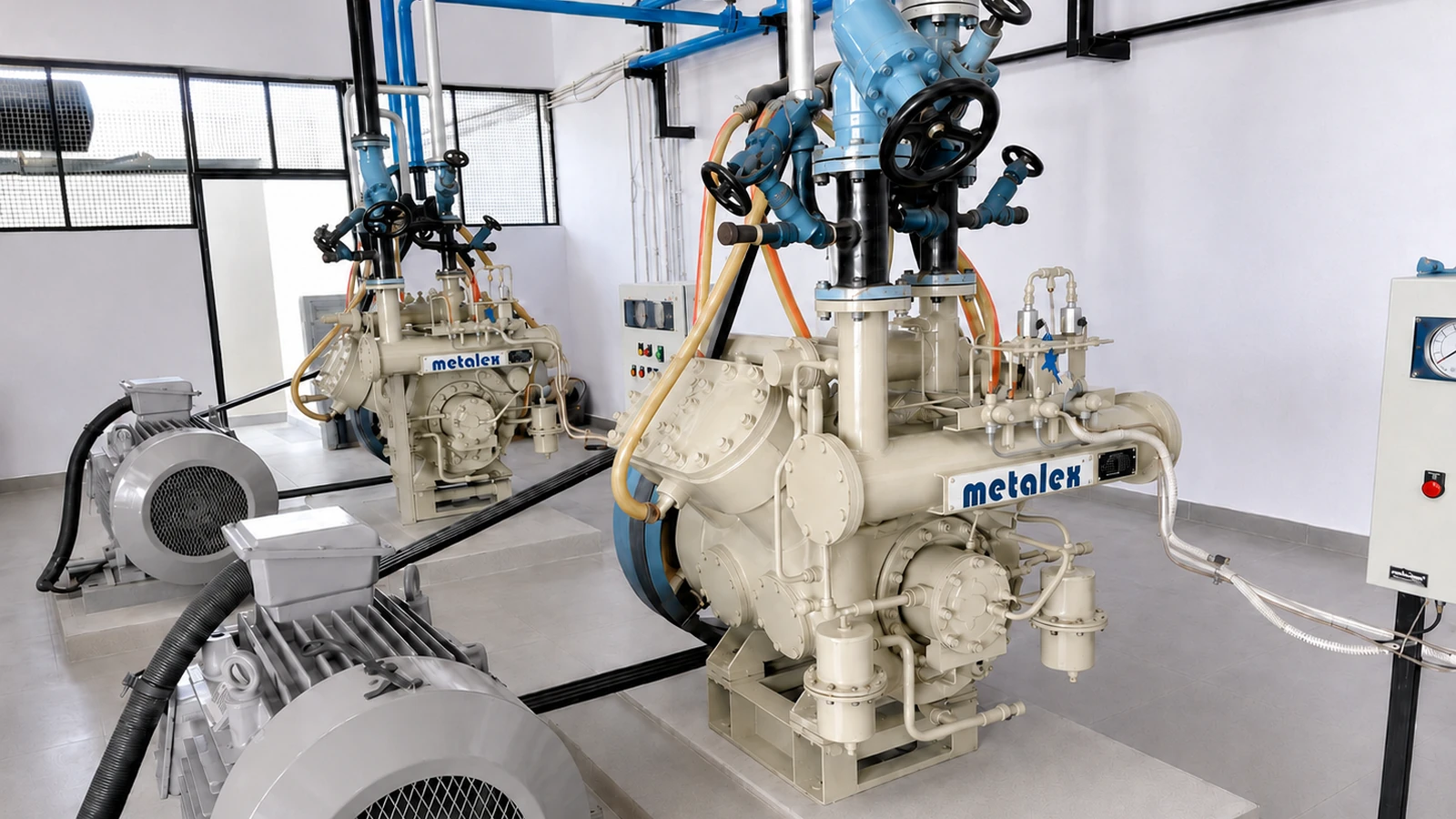
The industrial refrigeration cycle and components are easiest to understand as one continuous heat-transfer system. In an R717 ammonia plant, four core components create the basic cycle: the compressor, condenser, expansion stage and evaporator. Industrial installations then add receivers, pressure vessels, valves, purgers, controls and plant accessories around this core loop so the system can serve cold storage, ice plants, food processing, dairy and process cooling duties.
Ammonia absorbs heat in the evaporator and returns to the compressor as low pressure vapour. The compressor raises its pressure, the condenser rejects heat and produces high pressure liquid, the expansion stage reduces pressure, and the evaporator absorbs heat again. The cycle repeats continuously while the supporting plant equipment manages refrigerant storage, flow, separation, controls and service access.
Industrial refrigeration cycle and components
The refrigeration cycle transfers heat from a lower temperature space to a higher temperature heat-rejection point. In a cold storage plant, the useful cooling happens at the evaporator, while the compressor and condenser create the pressure and temperature conditions that allow that heat to be carried away from the room.
Metalex's current industrial cold storage planning guide explains the same vapour compression sequence used in large ammonia systems: compressor, condenser, expansion device and evaporator. This article looks at that sequence from a component and refrigerant-state viewpoint so plant owners can see how each stage connects to the complete R717 system.
The 4 core refrigeration components
Ammonia compressor
Raises the pressure of R717 vapour and provides the pressure difference that drives the refrigeration cycle.
Condenser
Rejects heat from the refrigerant and changes high pressure ammonia vapour into high pressure liquid.
Expansion stage
Reduces refrigerant pressure before the low temperature evaporating side of the system.
Evaporator
Absorbs heat from the cold room, product or process and returns ammonia vapour toward the compressor.
1. Ammonia compressor
The compressor is the driving machine of the cycle. It receives low pressure ammonia vapour from the evaporating side and compresses it to the higher pressure required for heat rejection at the condenser. In an industrial plant, compressor selection affects capacity, operating range, control strategy and the way the machine integrates with the rest of the refrigeration system.
Metalex manufactures reciprocating ammonia piston compressors for R717 industrial refrigeration. The current range includes the MX Series water cooled ammonia compressors, IS Series air cooled compressors and MXT Series air cooled ammonia compressors. Metalex selects the compressor around refrigeration capacity, evaporating temperature, condensing temperature, operating hours, site ambient condition, power supply, cooling-water availability, control preference and future expansion.
MX Series water cooled ammonia compressors
The Metalex MX Series water cooled compressor range is built around open type reciprocating R717 duty. Published Metalex information covers single stage and two stage models, cylinder-based capacity control and service-focused construction for continuous industrial refrigeration applications.
IS Series air cooled ammonia compressors
The IS Series is positioned for industrial sites where air cooled compressor operation suits the available utilities. Metalex states that the series is suitable for locations with hard-water conditions and is designed for high ambient temperatures up to 50°C, making it relevant for many warm-climate refrigeration plants.
MXT Series air cooled ammonia compressors
The MXT Series extends Metalex's air cooled R717 compressor platform into industrial duties requiring an efficient, service-friendly compressor architecture. Current Metalex data presents the series with capacity control per cylinder and no compressor water-cooling requirement.
2. Condenser
After compression, ammonia leaves the compressor as high pressure vapour. The condenser removes heat from this vapour and changes it into high pressure liquid refrigerant. This heat-rejection stage is directly connected to the compressor operating condition because the condensing temperature establishes the high-pressure side of the cycle.
Metalex manufactures MEC Series evaporative condensers for industrial refrigeration. Metalex's published selection approach considers refrigerant, wet-bulb temperature, condensing temperature and site condition. In a complete cold storage design, compressor and condenser selection are therefore coordinated rather than treated as separate equipment decisions.
Why wet bulb and condensing temperature matter
For an evaporative condenser, heat rejection is linked to the site wet bulb condition as well as the selected condensing temperature. Metalex therefore presents the MEC Series evaporative condenser as a project-selected range rather than a one-size equipment choice. Refrigerant, wet bulb temperature, condensing temperature, water quality, layout and site condition are reviewed together for final selection.
This connection is important because the condenser sets the high pressure side seen by the compressor. Matching condenser heat rejection with compressor duty helps the full refrigeration cycle operate around the intended design condition.
3. Expansion stage
Once ammonia has condensed, the liquid side carries refrigerant toward the low pressure part of the plant. The expansion stage creates the pressure reduction required before the evaporator. This pressure change prepares the refrigerant for useful heat absorption at the required room or process temperature.
The expansion device is selected as part of the refrigeration-system design for the required evaporating condition. Across the wider R717 circuit, Metalex ammonia refrigeration valves support isolation, controlled refrigerant flow and one-way flow functions in the plant piping.
4. Evaporator
The evaporator is the point where refrigeration becomes useful to the product or process. Low pressure ammonia absorbs heat from cold room air, product, process fluid or another controlled space. The resulting vapour returns toward the compressor and begins the cycle again.
In Metalex cold storage solutions, the evaporating side is planned around product type, storage temperature, room size, daily loading, pull down requirement, airflow and humidity. These inputs determine the refrigeration load and help define the evaporating condition used for compressor and system selection.
How ammonia changes through the cycle
Following the refrigerant state from one component to the next makes the industrial refrigeration cycle easier to read. Pressure, temperature and phase are connected, so the compressor, condenser, liquid side, expansion stage and evaporator must be considered as one system.
| Cycle point | Typical ammonia condition | What happens | Equipment context |
|---|---|---|---|
| Compressor inlet | Low pressure vapour | Vapour returns from the evaporating side. | Metalex MX, IS or MXT compressor selection is matched to suction and condensing conditions. |
| Compressor outlet | High pressure vapour | Pressure and temperature are raised for heat rejection. | The compressor delivers vapour to the condenser side. |
| Condenser outlet | High pressure liquid | System heat is rejected and ammonia condenses. | Metalex MEC Series evaporative condenser. |
| Receiver and liquid line | High pressure liquid | Liquid refrigerant is stored, balanced and distributed. | Metalex receivers, vessels and valves. |
| Expansion stage | Pressure reduced toward evaporating condition | Refrigerant is prepared for low temperature heat absorption. | Expansion control is selected around the refrigeration design. |
| Evaporator outlet | Low pressure vapour | Heat has been absorbed from the room or process. | Vapour returns to the compressor and the cycle repeats. |
Why the four components must be matched as one system
Industrial refrigeration performance comes from the relationship between the components rather than from one nameplate capacity. The compressor establishes refrigerant circulation and pressure lift, the condenser defines heat-rejection capability, the expansion stage connects the high and low pressure sides, and the evaporator converts available refrigerating effect into useful cooling.
The same compressor can operate at different capacities when evaporating or condensing conditions change. In the same way, condenser duty changes with heat rejection and site wet bulb, while the evaporator is governed by product load, room temperature, airflow and process requirements. Engineering the four components around one common duty point keeps the refrigeration cycle technically connected.
| Design input | Compressor effect | Condenser effect | Evaporating / liquid-side effect |
|---|---|---|---|
| Evaporating temperature | Defines suction condition and affects compressor capacity | Influences total system heat rejection through compressor work | Sets the operating level required for useful cooling |
| Condensing temperature | Defines the high pressure duty and compressor lift | Central selection condition for heat rejection | Defines the liquid-side pressure before expansion |
| Refrigeration load | Determines required compressor capacity and staging | Determines the heat that must be rejected | Determines evaporator and refrigerant-flow requirement |
| Site utilities | Influences MX, IS or MXT cooling architecture selection | Influences condenser arrangement and service planning | Influences controls, valves and plant layout |
| Operating profile | Influences capacity control and number of machines | Influences part-load heat rejection | Influences room pull down, holding duty and control response |
Supporting components in an industrial ammonia system
The four core components explain the thermodynamic cycle, but an industrial ammonia plant uses additional equipment to organise liquid storage, refrigerant separation, flow control, purging, automation and service access. These components become especially important in larger cold storage and process refrigeration plants.
| Supporting component | Role in the R717 plant | Metalex resource |
|---|---|---|
| High pressure receiver | Supports liquid refrigerant storage, system balance and service pump-down arrangements. | Metalex high pressure vessels |
| Pressure vessels | Support refrigerant storage, phase separation and plant-specific system functions. | Metalex plant equipment |
| Refrigeration valves | Support isolation, controlled flow and one-way refrigerant movement. | Metalex ammonia valves |
| Purgers | Help remove non-condensable gases and water from ammonia refrigeration circuits. | Metalex refrigeration purgers |
| Controls | Coordinate monitoring, capacity control and plant operation. | Metalex plant equipment |
High pressure receiver and liquid-side balance
A Metalex high pressure receiver provides liquid refrigerant storage on the high pressure side and supports system balance and service pump-down arrangements. Metalex offers horizontal and vertical ammonia receiver configurations, with final vessel selection based on refrigerant charge, required receiver volume, orientation, nozzle schedule, project code and plant layout.
Valves and purgers as part of the operating circuit
Metalex ammonia refrigeration valves cover globe, check and stop valve duties for controlled flow, one-way flow and line isolation. These functions help organise the liquid, suction, discharge and other refrigeration lines according to the plant piping design.
Metalex Air Purgers and Water Purgers support ammonia plant operation by removing non-condensable gases and water from the refrigeration circuit. Their role is connected to the system condition rather than to the four-component thermodynamic sequence, which is why they sit within the supporting plant-equipment layer.
Refrigerant flow through the industrial cycle
- Heat enters the evaporator. Product load, room transmission, door openings, people, lighting and process activity contribute to the refrigeration load.
- Ammonia absorbs that heat. R717 evaporates at the selected low pressure condition.
- The compressor raises vapour pressure. The selected Metalex compressor creates the pressure level required for heat rejection.
- The condenser rejects heat. High pressure ammonia vapour condenses into liquid refrigerant.
- The liquid side manages refrigerant. Receivers, vessels and valves support storage, balance and distribution.
- The expansion stage reduces pressure. Refrigerant is prepared for the evaporating condition.
- The evaporator absorbs heat again. The resulting vapour returns to the compressor and the cycle continues.
How the refrigeration cycle applies to cold storage
A cold storage refrigeration system starts with the product and duty. Storage temperature, room size, daily product loading, pull down time, product entering temperature, humidity requirement, door activity, ambient condition and operating hours all influence the refrigeration load.
These load inputs then connect directly to the cycle components. The evaporating condition influences compressor suction duty, the condensing condition influences compressor lift and condenser selection, and the liquid side must support stable refrigerant distribution to the evaporators. This is why a cold storage plant is engineered as one refrigeration system rather than as a collection of unrelated machines.
Metalex combines its R717 ammonia compressor range with condensers, vessels, valves, purgers and plant equipment for industrial refrigeration. For complete project planning, Metalex cold storage project solutions can cover technical planning, equipment selection, refrigeration integration, installation coordination, testing and commissioning support.
Pull down duty and holding duty create different load patterns
Cold storage load is not a single fixed number throughout the operating day. Pull down periods include the heat removed from incoming product together with room transmission, door activity and internal loads. Holding duty is centred on maintaining the required room and product condition after the target temperature has been reached.
This changing load pattern is one reason industrial plants use compressor capacity control and staged equipment selection. The Metalex ammonia compressor range can be reviewed with the expected operating profile so the machine configuration and wider refrigeration plant are selected around the real duty rather than only the peak figure.
Metalex's current product platform reflects this complete-system view: R717 reciprocating compressors, MEC evaporative condensers, high pressure receivers, ammonia valves, purgers and wider industrial refrigeration plant equipment are all presented within the same ammonia refrigeration ecosystem.
In a typical industrial layout, low pressure vapour returns from the evaporating side to the compressor in the machine room. The compressor sends high pressure vapour to the condenser, condensed liquid is organised through receivers and liquid-side piping, and the expansion stage feeds the low pressure evaporating side. Valves, vessels, controls and purging equipment support this circuit so each section can be operated as part of one engineered plant.
What data should be fixed before selecting the components?
Component selection becomes clearer when the design inputs are established before the equipment list is finalised. Metalex's current compressor selection guidance asks for the following operating information:
- Required refrigeration capacity for the cold room, process or production duty.
- Evaporating or suction temperature required by the application.
- Condensing temperature and site ambient or wet-bulb condition.
- Operating hours and expected load variation through the day or season.
- Power supply and utilities, including cooling-water availability where relevant.
- Control preference and capacity-control requirement.
- Future expansion that may influence compressor, condenser and plant-equipment planning.
Once these values are known, the compressor, condenser, receiver, valves, controls and evaporating side can be reviewed against the same operating duty. This keeps the refrigeration cycle technically connected from suction to heat rejection.
Metalex industrial refrigeration platform
Metalex's industrial refrigeration ecosystem includes reciprocating ammonia compressors, evaporative condensers, pressure vessels and plant equipment, refrigeration valves, purgers, controls, spares and service support.
The Metalex industries portfolio covers cold storage, dairy, agricultural produce, ice plants, seafood, food processing, pharma and process cooling applications. That broader equipment and application range allows the compressor and supporting components to be discussed within the same R717 system framework.
Core Metalex equipment
Planning an industrial ammonia refrigeration system?
Share the application, required refrigeration capacity, target temperature, evaporating condition, condensing condition, project location, operating hours and available utilities. Metalex can review the compressor and wider plant equipment requirement as one connected R717 refrigeration system.
Get QuotesIndustrial refrigeration cycle FAQ
The four core components are the compressor, condenser, expansion stage and evaporator. Industrial R717 plants then add receivers, vessels, valves, purgers and controls around this core cycle.
The compressor receives low pressure ammonia vapour from the evaporating side and raises its pressure for heat rejection at the condenser. Metalex offers MX Series, IS Series and MXT Series reciprocating ammonia compressors.
The condenser rejects heat from the high pressure ammonia vapour and converts it into high pressure liquid refrigerant. Metalex manufactures MEC Series evaporative condensers for industrial refrigeration.
A liquid receiver supports refrigerant storage, system balance and service pump-down arrangements on the high pressure side. Metalex supplies high pressure vessels for industrial refrigeration plants.
Industrial ammonia systems also use pressure vessels, receivers, refrigeration valves, purgers, controls and other plant equipment around the core cycle.
The cycle is selected around product load, storage temperature, room size, daily loading, pull down time, humidity, ambient condition and operating hours. Those inputs define the evaporating duty, compressor requirement, heat rejection and liquid-side design.
Metalex asks for required refrigeration capacity, evaporating temperature, condensing temperature, operating hours, application, site ambient conditions, power supply, cooling-water availability, control preference and planned future expansion.
The compressor duty depends on the selected evaporating and condensing conditions, while the condenser must reject the evaporator load plus compressor heat. Reviewing the Metalex compressor and MEC evaporative condenser around the same design condition keeps the high and low pressure sides technically matched.
They support the industrial plant around the core thermodynamic cycle. Receivers organise liquid storage, refrigeration valves control and isolate flow, and purgers manage non-condensable gases and water in R717 systems.