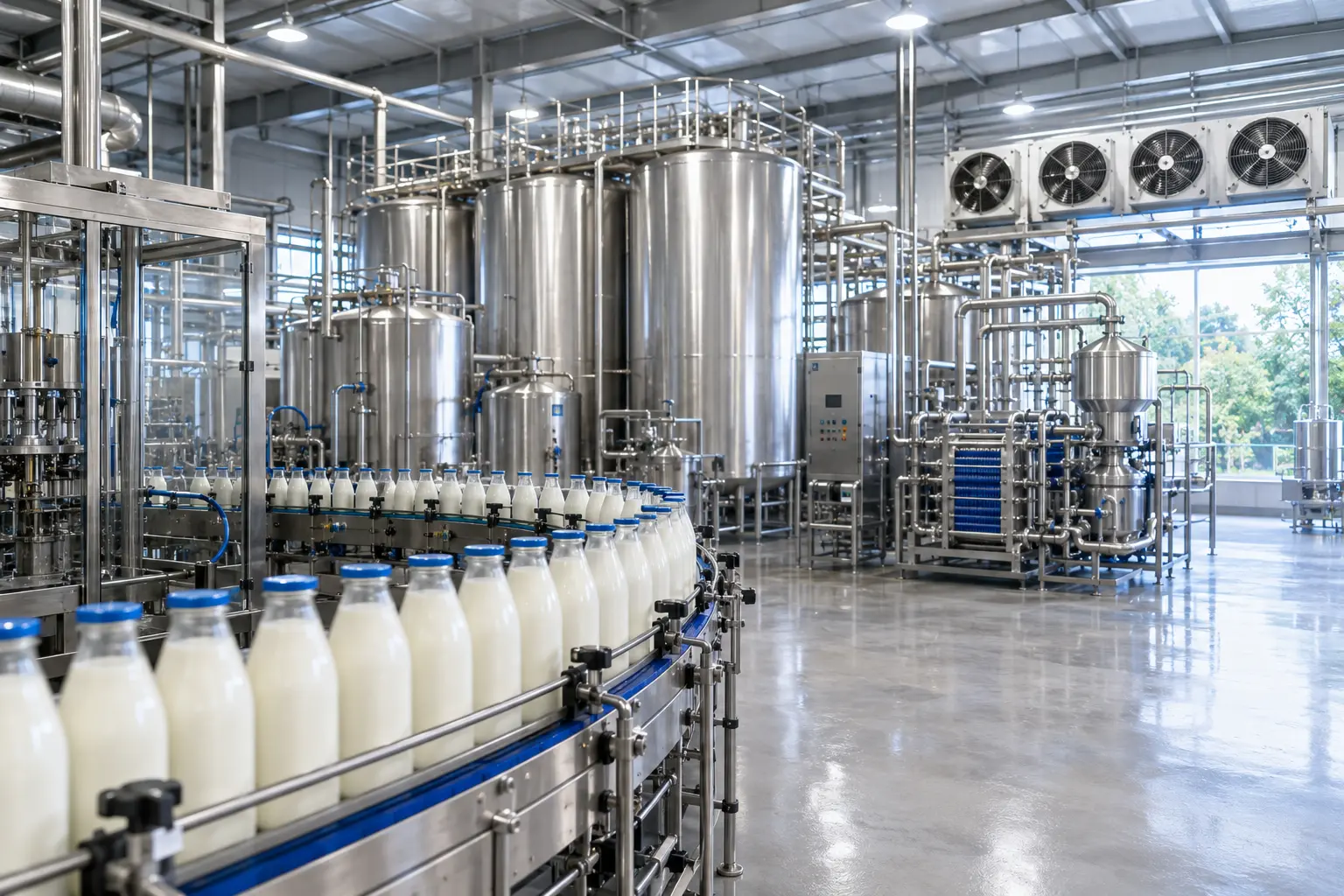
Milk arrives warm, arrives all at once, and its shelf life is decided in the first two hours. This is how the refrigeration system behind a chilling centre, a processing dairy and a frozen store is actually engineered — from load sheet to compressor selection to the power bill you live with for twenty years.
Why dairy refrigeration demand is rising.
A dairy refrigeration system in India is not a cold store with milk in it. It is a plant that must absorb a violent two-hour morning peak, hold several unrelated temperature bands at once, then idle through the afternoon without burning power it does not need.
Two funding signals are pushing new capacity into the ground. The revised National Programme for Dairy Development (NPDD) funds milk chilling plants, quality-testing laboratories and bulk milk coolers, with central assistance of 50% for most states and 75% in the North East, hilly areas and Union Territories. More than 5,100 BMCs totalling roughly 123 lakh litres of chilling capacity are already installed under the programme.
Running alongside it, the AHIDF dairy cold-chain route — the Animal Husbandry Infrastructure Development Fund — offers 3% interest subvention for eight years, including a two-year moratorium, on loans covering up to 90% of project cost for dairy processing and value addition. Individuals, private companies, MSMEs, FPOs and Section 8 companies are all eligible.
The practical consequence for engineers: more village-level chilling centres feeding larger processing dairies, and a sharp rise in ice-cream and frozen-dessert lines that need genuine low-temperature refrigeration rather than an oversized chiller. Get the load sheet wrong at the DPR stage and the plant pays for it every month for two decades.
Six duties, one machine room.
A single dairy carries several unrelated duties at once, each with its own evaporating temperature and its own load shape. Select a stage to see what it demands of the plant.
The defining duty. Milk arrives at ambient and must reach 4 °C inside the window that protects bacterial count — typically two hours or less from receipt. Sensible heat only, no phase change, but concentrated into a short, twice-daily spike.
- Evaporating
- −2 to +1 °C
- Load shape
- Sharp peak, 2 × daily
- Driver
- Pull-down time, not volume
- Buffer
- Ice bank / chilled-water storage
A holding duty. Insulated silos lose very little, so the refrigeration requirement is small against reception — but it runs continuously and must not be starved when the pasteuriser is calling.
- Evaporating
- −2 to 0 °C
- Load shape
- Steady, low
- Driver
- Silo insulation, agitation heat
The regeneration section of the plate heat exchanger recovers most of the heat, but final cooling needs chilled water close to freezing without risking ice on the plates. Secondary-fluid selection and glycol or brine concentration matter here.
- Evaporating
- −4 to −2 °C
- Load shape
- Continuous during run
- Driver
- Approach temperature, flow stability
Conventional chilled storage with pull-down cycles as fresh product enters. Infiltration through doors and dock openings frequently exceeds transmission through the panels — which is why door design deserves as much attention as insulation thickness.
- Evaporating
- −6 to −3 °C
- Load shape
- Cyclic over steady base
- Driver
- Infiltration, product entry temp
The most demanding duty in a dairy. Product leaves the continuous freezer at roughly −5 °C with about half its water frozen; hardening must remove the remaining latent heat fast enough to keep ice crystals small. Latent heat of fusion is ~334 kJ/kg of water content — an order of magnitude above the sensible load.
- Evaporating
- −38 to −42 °C
- Compression
- Two-stage with intercooling
- Load shape
- Intense, batch-driven
- Driver
- Freezing rate & crystal size
A holding duty again, but at a compression ratio where every inefficiency is amplified. Frost build-up on evaporator coils, defrost strategy and door discipline dominate real-world consumption far more than nameplate compressor efficiency.
- Evaporating
- −28 to −25 °C
- Compression
- Two-stage reciprocating
- Driver
- Insulation, defrost strategy
Add every peak together
Summing the arithmetic maximum of all six duties and buying one compressor to match. It reads as safe on paper and runs unloaded for most of the day.
Size against the actual load profile
Reception peaks at 05:00 and 17:00, hardening runs mid-shift, frozen storage is flat. A diversity-aware selection routinely lands 20–30% below the naïve sum — and runs closer to full load, where reciprocating machines are most efficient.
Chilling, cold storage and frozen are not the same.
These are three different engineering problems that happen to share a machine room. Treating them as one is the root of most underperforming dairy plants.
A heat-removal race
The design driver is pull-down time. Peak kW is high, running hours are short, and the plant spends most of the day at part load. Ice-bank tanks or chilled-water buffers decouple compressor sizing from the intake spike, letting you install less capacity and run it in a better efficiency band.
Practical consequence: two or three smaller compressors with sequenced staging beat one large machine that spends the afternoon unloaded and short-cycling.
A holding duty
Driven by transmission through the envelope, infiltration at doors and dock seals, respiration or fermentation heat where relevant, plus fans, lighting and personnel. Pull-down barely features. Insulation continuity and air distribution matter more than nameplate TR — covered at length in our industrial cold storage planning guide.
Air-curtain and dock-seal spend is almost always cheaper than the compressor capacity needed to cover the infiltration it prevents.
Where efficiency collapses
Below roughly −25 °C evaporating temperature, single-stage compression becomes punishing: pressure ratio rises, volumetric efficiency falls, and discharge temperature climbs to the point where oil degradation becomes a maintenance problem. Two-stage reciprocating compression with an intercooler is not a refinement here. It is the difference between a viable and an unviable power bill.
A useful rule: if the pressure ratio across a single machine exceeds about 8:1, stage it.
When ammonia becomes commercially suitable.
Ammonia refrigeration for dairy plants (R-717) generally makes commercial sense once total plant load crosses roughly 50–75 TR, or wherever a frozen or hardening duty exists at any capacity. The case is thermodynamic before it is financial.
| Property | R-717 ammonia | Typical HFC | Why it matters in a dairy |
|---|---|---|---|
| Latent heat at −10 °C | ~1315 kJ/kg | ~200 kJ/kg | Far lower mass flow for the same duty — smaller pipe, smaller pumps |
| GWP | 0 | 1,300 – 3,900 | No phase-down exposure over a 20-year asset life |
| ODP | 0 | 0 | — |
| Refrigerant cost | Very low | High | Matters on charges measured in hundreds of kg |
| Leak detection | Odour at ~5 ppm | Odourless | Leaks announce themselves long before they are dangerous |
| Safety group | B2L | A1 | Demands a designed machine room and trained operators |
Below that threshold, packaged fluorocarbon or transcritical CO₂ systems are often simpler to own. Above it, ammonia is what Indian dairies of scale actually run — and what Metalex has engineered for dairies across the country since 1968.
“The compressor is only as efficient as the system engineered around it.”
— Metalex Engineering TeamCompressors, condensers and pressure vessels.
Three decisions define your operating cost for the next twenty years. None of them are catalogue decisions.
Compressors — match the duty point, not the nameplate TR
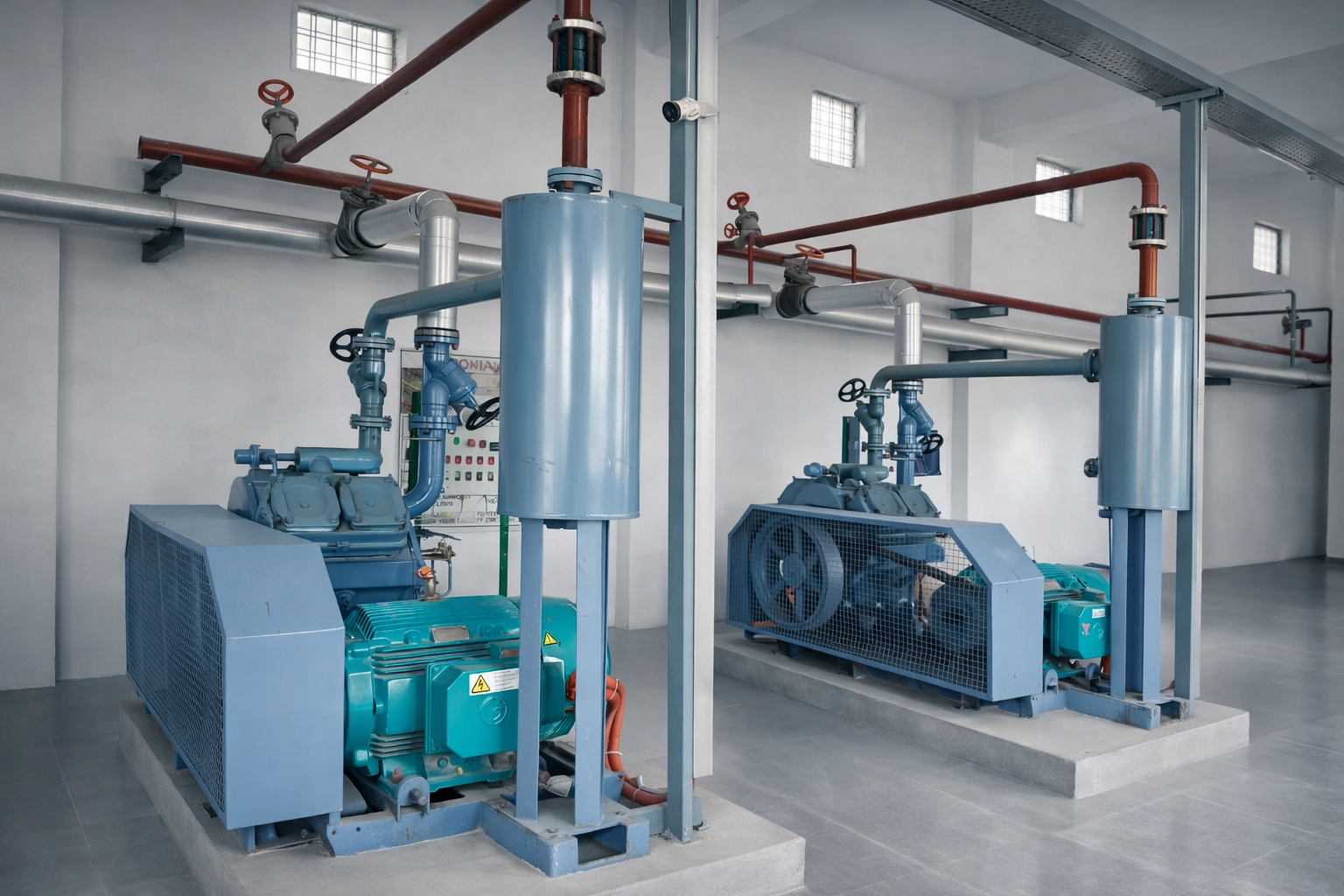
A compressor rated at 100 TR is rated at a stated evaporating and condensing temperature. Move the duty point and the number moves with it. Reciprocating ammonia compressors hold efficiency comparatively well at part load through cylinder unloading, which matters in a dairy where evening load is a third of the morning peak. Metalex builds the MX-Series water-cooled, IS-Series air-cooled and MXT-Series self-cooled piston compressor ranges for exactly this continuous-duty, high-ambient profile. Several smaller machines with sequenced staging beat one large one.
Condensers — the cheapest efficiency you will ever buy
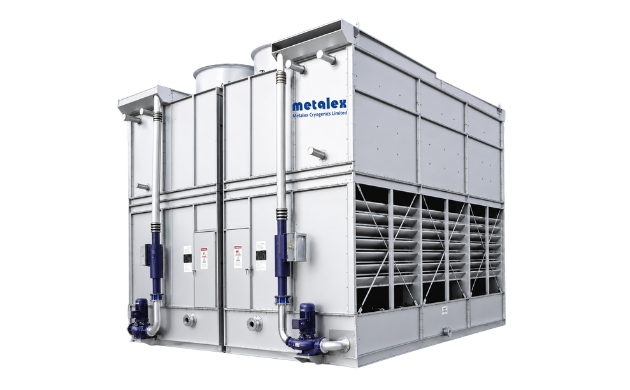
Compressor power falls roughly 2–3% for every 1 °C reduction in condensing temperature. In Indian ambient conditions, evaporative condensers — which reject heat against wet-bulb rather than dry-bulb temperature — are almost always the right answer, and generous sizing pays back faster than almost any other capital line.
Interactive · Condensing temperature vs power cost
Set connected compressor load, running hours and tariff, then move the condensing temperature to see the annual difference against a 45 °C baseline.
Indicative only. Assumes 2.5% compressor power change per °C of condensing temperature against a 45 °C baseline, and a 0.71 kg CO₂e/kWh grid factor. Real figures depend on compressor curves, wet-bulb conditions and load profile.
Vessels, separators and oil management
Liquid receivers, low-pressure receivers and intercoolers, oil pots and refrigeration purgers must be sized for real operating swings, not steady-state averages. Undersized separators carry liquid to the compressor; undersized high-pressure receivers destabilise the entire charge balance during pump-down. Vessels should be designed and certified to a recognised code — commonly ASME Section VIII Div. 1 — with statutory applicability under the SMPV(U) Rules confirmed for your vessel volumes. See the Metalex plant equipment range, ammonia pressure vessels, air and water purgers and our wider refrigeration project engineering capability.
Reducing electricity and operating cost.
Refrigeration typically accounts for 50–70% of a dairy's electricity bill. Tick the measures you have not yet implemented to see an indicative combined saving band.
These interact rather than add cleanly, which is why the tally applies a diminishing-returns factor. For purge-side efficiency, see Metalex Air Purgers for non-condensable gases and Water Purgers for water contamination in R-717 systems. For the full treatment see our guide to reducing power consumption in industrial refrigeration plants and the note on CRANE Temper heat-transfer fluids.
Safety, automation and redundancy.
Ammonia is efficient and well proven, but it is a toxic, pungent gas and the design has to respect that.
A compliant installation provides a dedicated machine room with adequate mechanical ventilation and emergency extract, fixed ammonia detection with staged alarm set-points, remote emergency stops outside the room, pressure relief valves manifolded to a safe discharge point, appropriate PPE and eyewash provision, and operators trained in emergency procedure. In India, IS 660 — the safety code for mechanical refrigeration — is the usual reference point; confirm statutory applicability of the SMPV(U) Rules with PESO for your specific vessel volumes.
Instrumentation earns its cost quickly. HB Products sensors and controls cover liquid level in separators and receivers, refrigerant quality and vapour-fraction sensing, and leakage detection — all of which turn an operator's guesswork into a trend line.
On redundancy the rule is simple: a dairy cannot stop. Perishable intake arrives every morning whether the plant is healthy or not. N+1 on compressors, standby condenser water pumps, and a critical spares inventory held on site — valve plates, gaskets, oil pumps, shaft seals, safety valves — are not optional line items for a plant of this type.
NPDD and AHIDF considerations.
Funding follows engineering, not the other way round.
- Confirm current scheme terms with your lender and use subsidy-support documentation where useful. Outlays, windows and eligibility conditions change; do not build a business case on a figure from an old circular.
- Make sure the DPR carries a defensible refrigeration load calculation with stated assumptions — not a vendor's round number. This is the section technical appraisers actually read.
- Keep equipment specifications performance-based and vendor-neutral enough to survive procurement scrutiny.
- Budget honestly for civil work, insulated panelling, electrical infrastructure and commissioning. These routinely exceed the refrigeration package and are the most common source of cost overrun.
Position on subsidy
Treat subsidy as a cost reduction on a project that is already viable. A plant whose economics only work with a scheme attached is not a plant — it is an exposure to policy risk with a compressor bolted to it.
Eight answers before you request a quote.
Answer these and you will receive a sized proposal rather than a brochure. Tick them off as you assemble the brief.
Browse the full dairy plant refrigeration equipment range, the industrial ice machine portfolio, and our refrigeration project portfolio. For a new dairy, explore Dairy Projects and the Milk Processing Plant solution; for an existing plant, see Plant Upgradation.
Common questions before you build.
At what plant size does ammonia refrigeration make sense for a dairy?
How much refrigeration capacity does a milk chilling plant need?
Why does condensing temperature matter so much to the power bill?
Should a new dairy install one large compressor or several smaller ones?
Can AHIDF or NPDD fund refrigeration equipment specifically?
How much margin should be built in for future expansion?
Technical note
Every figure in this article is indicative and intended for planning discussion. Final load calculations, compressor configuration, vessel sizing and safety provisions must be validated against the specific product mix, capacity, ambient design conditions and statutory requirements applicable to your site.